REPORTS
FIGUEIREDO’S TECHNIQUE: APPLICATION OF THE NURSING PROCESS IN THE LIGHT OF WANDA HORTA’S THEORY
TÉCNICA DE FIGUEIREDO: APLICACIÓN DEL PROCESO DE ENFERMERÍA A LA LUZ DE LA TEORÍA DE WANDA HORTA
TÉCNICA DE FIGUEIREDO: APLICAÇÃO DO PROCESSO DE ENFERMAGEM À LUZ DA TEORIA DE WANDA HORTA
https://doi.org/10.31011/reaid-2026-v.100-n.1-art.2623
1Samylle Santos Cardoso
2Simone Santos Souza
3Rejane Santos Barreto
4Ícaro José Santos Ribeiro
5Andreia Silva Rodrigues
6Mariane Teixeira Dantas Farias
1Discente do curso de enfermagem da Universidade Estadual de Santa Cruz. Ilhéus, Brazil. E-mail: sscardoso.efe@uesc.br. Orcid: https://orcid.org/0009-0006-0800-2707
2Enfermeira. Professora Assistente da Universidade Estadual de Santa Cruz. Ilhéus, Brazil. E-mail: sssouza1@uesc.br. Orcid: https://orcid.org/0000-0002-5283-6083
3Enfermeira. Professora Assistente da Universidade Estadual de Santa Cruz. Ilhéus, Brazil. E-mail: rsbarreto@uesc.br. Orcid: https://orcid.org/0000-0002-2973-0272
4Enfermeiro. Professor Visitante da Universidade Estadual de Santa Cruz. Ilhéus, Brazil. E-mail: ijsribeiro@uesc.br. Orcid: https://orcid.org/0000-0002-4389-7810
5Enfermeira. Professora do Centro Universitário Maurício de Nassau. Salvador, Brazil. E-mail: enfandreiarodrigues@hotmail.com. Orcid: https://orcid.org/0000-0002-0091-2849
6Enfermeira da Secretaria de Saúde do Estado da Bahia. Salvador, Brazil. E-mail: manomafarias@gmail.com. Orcid: https://orcid.org/0000-0003-4208-4911
Corresponding Author
Simone Santos Souza
Campus Soane Nazaré de Andrade, Rod. Jorge Amado, Km 16 - Salobrinho, Ilhéus - BA, Brazil. 45662-900. E-mail: sssouza1@uesc.br; phone: +55(73) 3680-5200
Submission: 11-08-2025
Approval: 05-12-2025
ABSTRACT
Introduction: Surgical debridement associated with the Figueiredo technique is an innovative procedure with a history of success in treating wounds containing large amounts of devitalized tissue. Nursing care is vital for patient recovery, requiring technical and scientific knowledge about the technique and an ethical and humane approach to ensure humanized care. Objective: To describe the application of the nursing process in the context of a patient undergoing surgical debridement associated with the Figueiredo technique, based on the Theory of Basic Human Needs. Methods: This is an experience report based on practices developed during the Perioperative Nursing course in a public hospital located in southern Bahia, Brazil. The theoretical framework of this work is the Nursing Process and the Theory of Basic Human Needs. Case report: In light of the Theory, it was found that the nursing problems identified in this study predominantly affected the patient's psychobiological and psychosocial dimensions. Based on a systematic assessment, corresponding nursing diagnoses were established, along with care prescriptions and the definition of expected outcomes. Through the implementation of nursing care, planned actions were systematically carried out, respecting the patient’s needs and institutional guidelines, promoting wound healing. Final considerations: The care provided followed the guidelines of the Nursing Process, ensuring a systematic, cyclical, deliberate, and interdependent approach, focused on the patient’s full recovery.
Keywords: Nursing; Nursing Care; Wound Healing; Surgical Wound.
RESUMEN
Introducción: El desbridamiento quirúrgico asociado a la técnica de Figueiredo es un procedimiento innovador, con antecedentes de éxito en el tratamiento de heridas con gran cantidad de tejido desvitalizado. La atención de enfermería es fundamental para la recuperación del paciente, y requiere conocimientos técnicos y científicos sobre la técnica, así como un enfoque ético y humano para garantizar una atención humanizada. Objetivo: Describir la aplicación del proceso de enfermería en el contexto de un paciente sometido a desbridamiento quirúrgico asociado a la técnica de Figueiredo, fundamentado en la Teoría de las Necesidades Humanas Básicas. Métodos: Se trata de un relato de experiencia, basado en vivencias durante la asignatura de Enfermería Perioperatoria en un hospital público localizado en el sur de Bahía, Brasil. El marco teórico de este trabajo es el Proceso de Enfermería y la Teoría de las Necesidades Humanas Básicas. Relato de caso: A la luz de la Teoría, se verificó que los problemas de enfermería identificados en este estudio incidieron predominantemente en las dimensiones psicobiológica y psicosocial del paciente. A partir de la evaluación sistematizada, se establecieron los diagnósticos de enfermería correspondientes, además de la prescripción de cuidados y la definición de los resultados esperados. Mediante la implementación de los cuidados de enfermería, las acciones planificadas fueron ejecutadas de forma sistemática, respetando las necesidades del paciente y las directrices institucionales, favoreciendo la recuperación de la lesión. Consideraciones finales: La atención brindada siguió las directrices del Proceso de Enfermería, garantizando un enfoque sistemático, cíclico, deliberado e interdependiente, centrado en la recuperación integral del paciente.
Palabras clave: Enfermería; Atención de Enfermería; Cicatrización de Heridas; Herida Quirúrgica.
RESUMO
Introdução: O desbridamento cirúrgico associado a técnica de Figueiredo é um procedimento inovador, com histórico de sucesso no tratamento de feridas com grande quantidade de tecido desvitalizado. A assistência do enfermeiro é vital para a recuperação do paciente, exigindo conhecimento técnico e científico sobre a técnica e uma abordagem ética e humana para garantir o cuidado humanizado. Objetivo: descrever a aplicação do processo de enfermagem no contexto de um paciente submetido ao desbridamento cirúrgico associado com a técnica de Figueiredo, fundamentado na Teoria das Necessidades Humanas Básicas. Métodos: Configura-se como um relato de experiência, baseado nas vivências durante a disciplina de Enfermagem Perioperatória em um hospital público localizado no sul da Bahia. Este trabalho possui como arcabouço teórico o Processo de Enfermagem e a Teoria das Necessidades Humanas Básicas. Relato de caso: À luz da Teoria verificou-se que os problemas de enfermagem identificados neste estudo incidiram predominantemente sobre as dimensões psicobiológica e psicossocial do paciente. A partir da avaliação sistematizada, foram estabelecidos os diagnósticos de enfermagem correspondentes, além de prescrição de cuidados e definição dos resultados esperados. Por meio da implementação dos cuidados de enfermagem, as ações planejadas foram executadas de maneira sistemática, respeitando as necessidades do paciente e as diretrizes institucionais, promovendo a recuperação da lesão. Considerações finais: A assistência prestada seguiu as diretrizes do Processo de Enfermagem, garantindo uma abordagem sistemática, cíclica, deliberada e interdependente, focada na recuperação integral do paciente.
Palavras-chave: Enfermagem; Cuidados de Enfermagem; Cicatrização; Ferida Cirúrgica.
INTRODUCTION
Tissue alterations of the cutaneous epithelium may result from multiple factors, such as the presence of chronic diseases, infections or physical trauma. In this context, the literature recognizes debridement as an indispensable step in the healing process, since it favors the transition from the inflammatory phase to the proliferative phase, stage characterized by the deposition of granulation tissue and beginning of tissue regeneration, usually started between the 3rd and 5th day after injury1.
Currently, different modalities of debridement are used in clinical practice, among them the mechanical, autolytic, enzymatic, instrumental conservative and surgical, being the method chosen based on clinical criteria, injury conditions and patient, as well as in the team experience2. Among these techniques, the association between surgical debridement and Figueiredo’s technique stands out, which consists in the application of a polypropylene prosthesis with function of isolation of the injured area. This approach has been shown to be effective in complex cases, such as osteomyelitis, by promoting secondary intention healing, tissue protection and preservation of limbs affected by extensive infections3.
From the nursing point of view, the debridement process requires systematic evaluation of the wound and elaboration of an individualized therapeutic plan. The nursing team, especially the nurse, plays a fundamental role in the safe conduct of care and should be able to apply evidence-based interventions and properly record the behaviors adopted4.
Especially, regarding the Figueiredo’s technique, there is a lack of technical-technological products that guide the professional practice of nursing. The description of this experience contributes to the advancement of scientific knowledge by addressing a little-explored assistance technology in the scientific production of the area, reinforcing the importance of its incorporation into care practices. In addition, the need for continuous training of nursing professionals is highlighted, ensuring the quality and safety of care.
The standardization of the Nursing Process, according to COFEN Resolution n. 736/2024, reaffirms its importance as a methodological and scientific instrument for the profession5. The effective implementation of the Nursing Process (NP) in complex contexts, as presented, collaborates for the development of evidence-based protocols, optimizing institutional resources and raising the standard of care provided.
Thus, the present report aims to describe the application of the Nursing Process (NP) in the context of a patient submitted to surgical debridement associated with the Figueiredo’s technique, based on the Theory of Basic Human Needs.
METHODS
This is an experience report with a reflective approach, focused on the application of NP in a patient with skin lesion treated by Figueiredo’s technique. The experience was lived in the second half of 2023, within the discipline of Perioperative Nursing. This discipline is an essential curricular component of the undergraduate course in Nursing, with a practical workload of 90 hours, distributed in units of surgical infirmary, surgical center and central material and sterilization. The students are organized in pairs and follow patients throughout the perioperative period, implementing the Systematization of Nursing Care (SNC) in an individualized, integral and humanized way.
The hospital institution, where the practice was held, is configured as a macro-regional reference, with 225 beds and service to more than 70 municipalities, highlighting specialties such as cardiology, neurosurgery and traumatology. It also has an advanced technological structure for diagnostic imaging, with features of computed tomography, magnetic resonance and X6 ray.
The care provided was guided by the NP, as recommended by COFEN Resolution n. 736/2024, which structures clinical reasoning and professional judgment in five interdependent stages: evaluation, diagnosis, planning, implementation and evolution5. The evaluation comprised the collection of subjective and objective data, complemented by complementary examinations. The diagnosis was based on the NANDA-I taxonomy, allowing accurate identification of patient needs. The planning contemplated the definition of measurable care goals, and the prescription of interventions was based on evidence and protocols. The implementation was conducted according to the professional competencies and, finally, the evolution made it possible to analyze the results, promoting the replanning necessary for the continuity of care5,7.
As a theoretical framework, the Theory of Basic Human Needs (TBHN) of Wanda Horta was adopted, which recognizes the person as a biopsychosocial being, emphasizing care focused on fundamental human needs, allowing a technical and ethical performance based on the balance of vital functions and the acceptance of the singularities of the subject8.
The data were organized and analyzed according to an inductive approach, allowing the construction of interpretations based on empirical material. The findings were presented through textual descriptions and an infographic, ensuring consonance with the objective and experience presented. It should be noted that, since this is an experience report, the submission and evaluation by the Research Ethics Committee (REC), as recommended by the current regulation, was not necessary9.
RESULTS AND DISCUSSION
During the practical activities of the Perioperative Nursing discipline, assistance was provided to a patient undergoing surgical debridement of soft parts, with application of the Figueiredo’s technique, for the treatment of infection in the left calcaneus, secondary to polytrauma caused by automobile accident.
The patient, male, 23 years old, was admitted by regulation of the Emergency Mobile Care Service (SAMU) after automobile collision, presenting an exposed fracture in the left lower limb (LLL), with syncope report at the time of trauma and pain complaint of moderate to severe intensity in the affected region. In the initial evaluation, the patient was in a semi-Fowler position, conscious and oriented in time and space, communicative, with humor preserved, but anxious about the complexity of the clinical picture and the functional prognosis. Moderate pain in left knee and severe pain in left calcaneus, irregular sleep, adequate food acceptance, satisfactory oral hydration, absence of comorbidities reported and denial of previous use of drugs, vesical eliminations present and without alterations and intestines absent for 6 days.
The physical examination revealed a patient with afebrile, normotensive, eupneic, 99% oxygen saturation in ambient air, stained mucous membranes, anicteric sclera and photoreacting pupils. The pulmonary auscultation revealed present and symmetrical vesicular murmurs, without adventitious noises. The cardiac auscultation showed normophonetic bulges in two times, without blowing. Abdominal distension was observed with hypoactive hydroaerial noise and an abdominal discomfort report, suggesting intestinal constipation. Urinary excretions present and unchanged. Symmetrical limbs, without edemas, but with muscular hypotrophy in MIE, attributed to prolonged immobilization by external fixator.
The surgical wound was located in the posterior and lateral face of the left foot, covering the calcaneus and insertion of the Achilles tendon. Partial suture dehiscence was observed, with irregular edges, maceration, presence of devitalized tissue with yellowish scab and thick purulent exudate — findings compatible with local infection. The perilesional skin presented hyperemia and edema, in addition to visible infiltration. The lesion evolved in an unsatisfactory way, configuring impaired healing process. The matron promptly notified the nurse and the nursing technician about the condition, in addition to guiding the patient to seek clarification with the attending physician.
During hospitalization, laboratory tests supported the clinical evaluation and informed therapeutic decisions. The hemogram, due to its practicality and cost-benefit ratio, proved to be of fundamental importance in the monitoring of the picture. Severe normocytic anemia was observed, characterized by reduced hemoglobin and hematocrit, with mean corpuscular volume (MCV) within normal limits, suggesting hemorrhagic etiology, consistent with the history of serious traumatis10. In the leucogram, leukocytosis was evidenced with left deviation, increase of segmented neutrophils and rods, configuring an acute inflammatory response compatible with bacterial infection11. These laboratory findings corroborated the need for immediate drug interventions, such as antibiotics, analgesics, corticosteroids, antiemetic, electrolytic solutions and anticoagulants.
In the course of hospitalization, it was found the need for surgical debridement, performed by the Figueiredo’s technique, an innovative approach developed by the surgeon Leandro Azevedo de Figueiredo. The technique consists in the application of polypropylene prosthesis on the wound bed, promoting healing by second intention, with advantages such as isolation of the lesion against external aggressions, stimulation to the granulation tissue, no need for grafting and low operating cost3.
After the patient was submitted to surgical debridement associated with the Figueiredo’s technique, a favorable clinical evolution was observed and assistance focused on pain assessment and management, monitoring of vital signs and daily evaluation of the operative wound, observing size, depth, presence of exudate and odor.
The wound had a polypropylene plate fixed anatomically in the bed of the lesion, so that its fixation was by means of sutures to its edges, being evident its function as a mechanical barrier, reducing the risk of external contamination. It had irregular edges delimited surgically, presence of granulation tissue and residual foci of whitish tissue, being suggestive for fibrin tissue, presence of serossanguinolent exudate in small amount, without signs of purulent exudate, and the skin around the wound had mild edema and erythema, but no clear signs of active infection.
Based on the initial evaluation and the patient’s history, the main nursing problems were identified: orthopedic injury of soft parts in the left calcaneus and abrasions in the lower left limb secondary to the automobile accident; Severe pain in the left calcaneus and moderate in the knee; alteration of balance due to injury to the calcaneus and use of external fixator, impaired sleep, anxiety and lack of hygiene.
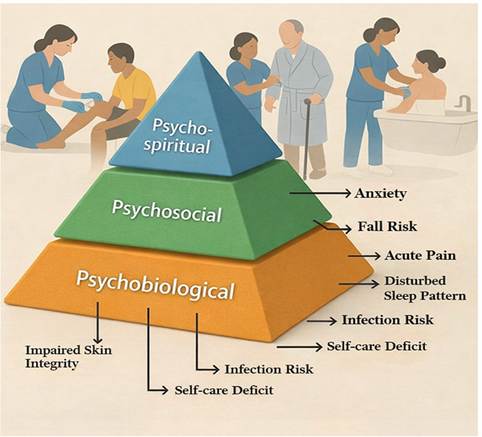
In the light of the Theory of Affected Human Needs, proposed by Wanda Horta, it was found that the nursing problems identified in this study predominantly focused on the psycho-biological and psychosocial dimensions of the patient. From the systematized evaluation, the corresponding nursing diagnoses were established, as illustrated in the subsequent infographic (Image 1), which synthesizes the relationship between each affected need and the traced diagnoses.
It is important to note that, in the clinical case analyzed, there were no changes related to the psycho-spiritual dimension of basic human needs. This finding reflects the specificity of the condition presented by this patient and does not exclude the possibility that, in other clinical contexts, this dimension is equally impacted, requiring directed nursing interventions.
Image 1 - Application of the nursing process in light of Wanda Horta’s Theory in a patient with prolipopilene plaque application in lower limb lesion
Source: created by the author (2025).
After the initial evaluation, priority nursing diagnoses were established according to the NANDA, as well as care prescription and expected postoperative results7. The first diagnosis was damaged skin Integrity related to the surgical procedure and abrasive agent (abrasions in MIE), evidenced by the presence of wound with serossanguinolent exudate, granulation tissue and fibrin, being associated with the psycho-biological dimension, mucosal cutaneous integrity of the TBHN. The specific interventions of nursing care aimed at injury with the application of the Figueiredo’s technique include: daily dressings with aseptic technique, maintaining the specific care not to remove the polypropylene plate, which acts as a protective barrier in the wound bed; examine the lower extremities for the presence of edema, skin color, hydration, odor and drainage every 8 hours or as needed (in cases of clinical worsening, perform immediate evaluation); change the dressing and coverage daily or according to institutional protocol (may vary according to the saturation of the dressing, presence of exudate or medical indication); compare and record perilesional skin every 12 hours or whenever there are significant changes; evaluate test results (blood count and leucogram) when necessary, to evaluate the systemic condition of the lesion recovery process; use barrier cream as a cover in the perilesional area to prevent maceration of edges.
The proper evolution of the healing process is expected with presentation of skin color compatible with adequate perfusion (granulation tissue and absence of necrosis) in up to 14 days and absence of signs of local infection (foul odor, purulent exudate, pronounced hyperemia) during the period of hospitalization and recovery from injury.
The second diagnosis, also associated with the category of psychobiological needs, immune regulation, of TBHN, was: Risk of infection related to the presence of surgical wound and implantation of synthetic material (polypropylene plate). Having as interventions: monitor local signs (erythema, edema, purulent exudate) and systemic (fever, malaise) of infection in the 24 hours and perform the change of dressing daily, maintaining strict aseptic technique. As a result of these actions, the absence of infection is expected with a stable clinical evolution of the wound. Understanding the factors that influence the occurrence of infections in the postoperative period of surgeries allows health professionals to broaden their care strategies and intervene more effectively in risk factors, aiming at reducing surgical site infections (SCI)13.
Also listed as psychobiological need, painful perception, another diagnosis was: Acute pain related to postoperative inflammatory process, evidenced by verbal report of mild pain, need for analgesia and facial expression of discomfort. It is the responsibility of the nurse to perform a complete evaluation of pain, including start/duration, frequency, intensity from the Numerical Scale of Assessment (NSA), in addition to assessing severity daily; ensure that the patient receives accurate analgesia care as needed; keep the calcaneus floating in order to avoid pressure point in 24 hours. As an expected result, the patient should report local discomfort reduction with effective pain relief or control reported by the patient (ideally ≤ 3/10 NSA) within 24 hours. It should be noted that the intensity of pain decreased, according to patient reports, soon after the surgical procedure.
A research that investigated nursing care in the postoperative period of surgical debridement performed in primary health care also signaled the need for more careful management concerning pain control12. The authors affirm that it is up to the nurse to be attentive to the prioritization of the diagnosis of Acute Pain during the implementation of nursing actions and interventions, especially in the care aimed at the patient in postoperative orthopedic, among other contexts. Acute pain is, among the NANDA taxonomy, one of the most frequent diagnoses in orthopedia13.
Another diagnosis listed in the psychobiological needs, sleep and rest, of TBHN is sleep pattern disorder related to pain and anxiety evidenced by irregular sleep report. With the following nursing prescriptions: to adapt the lighting of the ward room at night; administer medicines as prescribed by a doctor for pain relief; encourage deep breathing as a relaxation technique before sleep and communicate medical staff on the need for re-evaluation of surgical wound, since pain that brings impairment to sleep conciliation. Improvement in sleep quality and continuity is expected within 3 days.
Still in the category of psychobiological needs, body care, of TBHN, nursing diagnosis is chosen: Deficit in self-care related to mobility limitation and presence of external fixator evidenced by partial dependence for bathing and intimate hygiene. With the following prescriptions: assist or supervise the patient during bathing and encourage active participation of the patient in daily care during the period of hospitalization. There will be the maintenance of proper body hygiene and reduction of the risk of infection associated with inadequate hygiene in up to 24 hours.
During the anamnesis, in the initial evaluation, the patient manifested a feeling of insecurity and showed signs of anxiety related to the evolution of his health status and the time of hospitalization. In the preoperative period, a more pronounced restlessness was observed, reflecting high levels of anxiety. However, in the postoperative period, there was improvement in this aspect, with reduced agitation and greater emotional stability.
The psychological variables, such as fear and anxiety, demonstrated by the patient during the preoperative period may influence the intensity of postoperative pain in people undergoing elective surgery14. Therefore, it is extremely important to plan and implement nursing interventions aimed at managing anxiety and fear in order to mitigate the suffering of surgical patients.
Finally, in view of the patient’s concerns regarding his health status and length of stay, it was identified the diagnosis of Anxiety related to hospitalization and surgical procedure, evidenced by verbalization of concern, irregular sleep and restlessness, belonging to the psychosocial category of TBHN. Thus, it was sought to reduce anxiety and greater participation of the patient in the treatment, through the implementation of the following nursing care: establish empathic and welcoming communication with the patient in 24 hours; allow the patient to express fears and concerns during the hospitalization period; explain clearly the surgical procedure, the care plan and the expected evolution and encourage the presence of family members and the possibility of psychological support insertion. It is expected to reduce the levels of anxiety reported by the patient; more regular sleep and restorative rest; demonstrated understanding about the treatment and active participation in the care and acceptance of the therapeutic plan in up to 3 days.
Finally, included in the safety category of the psycho-social level, was listed the diagnosis of nursing Risk of fall related to impaired mobility. It was therefore necessary to monitor the way of walking, balance and level of fatigue with walking and the ability to transfer from bed to chair and vice versa daily; guide the patient to call help to move whenever necessary; provide accessory devices such as crutches, hygienic chair, whenever necessary, considering the pain and comfort of the patient and classify in the risk assessment as falling risk. The risk of falls due to imbalance or muscle weakness is expected to be reduced and there will be a gradual improvement in locomotion capacity and functional independence during the hospitalization period.
The planned actions were carried out in a systematic way, respecting the needs of the patient and institutional guidelines. The evolution of the patient was constantly monitored, allowing the evaluation of the effectiveness of interventions.
As a result, when returning to verify the patient’s evolution, based on the analysis of nursing diagnoses established before and after surgery, it was possible to evaluate the clinical evolution of the patient and the effectiveness of the proposed interventions. In the preoperative period, the patient had several nursing problems, such as intense pain in the left calcaneus and moderate in the knee, alteration of balance due to injury and use of external fixator, absent intestinal elimination, impaired sleep, anxiety related to the state of health, as well as a deficit in body hygiene.
After surgery, although certain problems persisted, they presented with different etiologies and a lower degree of severity or clinical risk. Pain, for example, became characterized as acute pain related to the postoperative inflammatory process. It can be observed the reduction of pain with report of mild intensity pain, improvement in tissue perfusion of the lower left limb, favorable evolution of the surgical wound with reduction of the risk of infectious complications and decrease of the state of restlessness with reduction of agitation and greater emotional stability.
It is concluded, therefore, that some of the problems identified in the preoperative period were resolved or controlled, while others persisted with distinct characteristics and were adequately managed in the care plan. In addition, new diagnoses emerged as a consequence of the surgical procedure and were recognized and treated by the nursing team, contributing to a favorable clinical evolution of the patient. Thus, the assistance provided followed the guidelines of the Nursing Process, ensuring a systematic approach, cyclical, deliberate and interdependent, focused on the integral recovery of the patient.
FINAL THOUGHTS
This experience report provided an enriching academic and professional experience in the context of the discipline of Perioperative Nursing, enabling the effective integration between theory and practice in an articulated and dynamic way. The follow-up of the patient provided not only direct clinical observation, but also in-depth research about the innovative technique used, its indications, advantages and applicability, considering that it was a procedure in the process of dissemination in care practice. This experience made it possible to systematically monitor the clinical evolution of the patient after the application of the method.
This work highlighted the relevance of integration between the Nursing Process and the Theory of Basic Human Needs in perioperative care, allowing an integral approach that contemplated local aspects of the lesion and systemic repercussions, emotional and social healing process. The application of this strategy favored clinical decision-making based on evidence and directed to the real needs of the patient, promoting humanized care, safe and effective.
The experience highlighted the importance of effective communication with the multiprofessional team, adequate management of pain and clear guidelines, essential elements for recovery and well-being of the patient. This reinforces the central role of nursing in surgical care, based on systematization of care, evidence-based practice and commitment to quality and comprehensiveness of care.
REFERENCES
1. Bicalho FF, Bicalho PF, Cruz SO, Rebelin AS, Celestino MJ, Rocha DFS, et al. Cicatrização de feridas pós-cirúrgicas: novas abordagens terapêuticas para melhorar a cicatrização e reduzir infecções. Braz J Implantol Health Sciences [Internet]. 2024 [citado 2025 Ago 08]; 6(11): 3094–03. DOI: https://doi.org/10.36557/2674-8169.2024v6n11p3094-3103
2. Miranda JTS, Silva ES, Tavares WS, Moreira DC, Mello MVFA. Conhecimento de enfermeiros sobre desbridamento de feridas em uma unidade de terapia intensiva na amazônia. Rev Enferm Atual In Derme [Internet]. 2023 [citado 2025 Ago 08]; 97(3):e023123. DOI: https://doi.org/10.31011/reaid-2023-v.97-n.3-art.1550
3. Figueiredo LA, Ribeiro RS, Figueiredo PH, Lima ALM, Oliveira FM de, Oliveira Júnior DS. Comparação entre as técnicas de Figueiredo e de reconstrução volar VY de Atasoy-Kleinert no tratamento de lesões transversas e oblíquas dorsais de ponta de dedo. Rev Bras Ortop [Internet]. 2024 [citado 2025 Ago 08]; 59(05): e712-e718. DOI: https://doi.org/10.1055/s-0042-1749203
4. Mina CC, Santos ES, Nascimento VS, Silva MDS. Preparo do leito da ferida por meio do desbridamento: uma revisão integrativa. Rev Enferm. Atual In Derme [Internet]. 2024 [citado 2025 Ago 08];98(3):e024378es. DOI: https://doi.org/10.31011/reaid-2024-v.98-n.3-art.2343
5. Conselho Federal de Enfermagem. Resolução nº 736, de 17 de janeiro de 2024. Cofen atualiza resolução sobre implementação do Processo de Enfermagem. Brasília-DF: COFEN; 2024. [citado 2025 Ago 08]. Disponível em: https://www.cofen.gov.br/resolucao-cofen-no-736-de-17-de-janeiro-de-2024/
6. Bahia. Secretaria de Saúde. Hospital Regional Costa do Cacau [Internet]. [citado 2025 Abr. 19]. Disponível em: https://www.saude.ba.gov.br/hospital/hrcc/#.
7. Herdman TH, Kamitsuru S, Lopes CT. Diagnósticos de Enfermagem da NANDA-I: Definições e Classificação 2024-2026. Porto Alegre: Artmed Editora; 2024.
8. Horta WA. Enfermagem: teoria, conceitos, princípios e processo. Revista da Escola de Enfermagem da USP [Internet]. 1974 [citado 2025 Ago 08];8(1):7-17. Disponível em: https://www.scielo.br/j/reeusp/a/z3PMpv3bMNst7jCJH77WKLB/?format=pdf&lang=pt.
9. Ministério da Saúde (BR). Conselho Nacional de Saúde. Resolução n° 510, de 7 de abril de 2016. Trata sobre as diretrizes e normas regulamentadoras de pesquisa em ciências humanas e sociais. Diário Oficial da União, Brasília-DF; 24 maio 2016 [citado 2025 Ago 08]. Disponível em: https://bvsms.saude.gov.br/bvs/saudelegis/cns/2016/res0510_07_04_2016.html.
10. Araújo FMS. Alterações no hemograma nas infecções virais e bacterianas: uma revisão de literatura. 2023. 43f. Trabalho de Conclusão de Curso (Graduação em Biomedicina), Centro de Biociências. Universidade Federal do Rio Grande do Norte, Natal, 2023.
11. Flores DPAB, Da Costa VÍB. O Uso Profilático de Antimicrobianos no Tratamento Cirúrgico em Hospitais. Ensaios e Ciência: Ciências Biológicas, Agrárias e da Saúde; 2022;26(1):78-86. [citado 2025 Ago 08]. Disponível em: https://ensaioseciencia.pgsscogna.com.br/ensaioeciencia/article/view/9342.
12. Lima SAA. Diagnóstico de enfermagem risco de infecção de sítio cirúrgico no pós-operatório de cirurgia de emergência. 2022. 26 f. Trabalho de Conclusão de Curso (Bacharelado em Enfermagem) - Instituto de Enfermagem, Universidade Federal do Rio de Janeiro, Macaé, 2022.
13. Silva MB. Engelman B, Figueiredo MS, Almeida MDA. Linguagens padronizadas de enfermagem em ortopedia na perspectiva do nursing role effectiveness model. Rev Gaúcha Enferm. 2022;43(1):e. 20210321.
14. Teixeira GL, Marques DG, Santos EAD, Hortense P, Napoleão AA, Carvalho ECD, et al. Efeitos mediadores do medo e ansiedade pré-operatórios na intensidade da dor pós-operatória. Acta Paul Enferm [Internet]. 2024 [citado 2025 Ago 08]; 37:eAPE02305, 2024.
Funding and Acknowledgments:
We declare that this research received no funding.
Conflict of Interest Statement:
“Nothing to declare.”
Authorship Criteria (Author Contributions):
Samylle Santos Cardoso: Contributed substantially to the conception and/or planning of the study; to the acquisition, analysis, and interpretation of the data; as well as to the writing and final approval of the published version.
Simone Santos Souza: Contributed substantially to the conception and/or planning of the study; to the acquisition, analysis, and interpretation of the data; as well as to the writing and final approval of the published version.
Rejane Santos Barreto: Contributed substantially to the conception and/or planning of the study; to the acquisition, analysis, and interpretation of the data; as well as to the writing and final approval of the published version.
Ícaro José Santos Ribeiro: Contributed substantially to the analysis and interpretation of the data; as well as to the writing and final approval of the published version.
Andreia Silva Rodrigues: Contributed substantially to the analysis and interpretation of the data; as well as to the writing and final approval of the published version.
Mariane Teixeira Dantas Faria: Contributed substantially to the analysis and interpretation of the data; as well as to the writing and final approval of the published version.
Scientific Editor: Ítalo Arão Pereira Ribeiro. Orcid: https://orcid.org/0000-0003-0778-1447
Rev Enferm Atual In Derme 2026;100(1): e026020
 Atribuição
CCBY
Atribuição
CCBY