ORIGINAL ARTICLE
INSTAGRAM AS AN INFORMATIONAL MEDIUM FOR PROMOTING SELF-CARE AND ACTIVE AGING: A NETNOGRAPHIC ANALYSIS
INSTAGRAM COMO MEIO INFORMATIVO PARA PROMOÇÃO DO AUTOCUIDADO E ENVELHECIMENTO ATIVO: UMA ANÁLISE NETNOGRÁFICA
INSTAGRAM COMO MEDIO INFORMATIVO PARA LA PROMOCIÓN DEL AUTOCUIDADO Y DEL ENVEJECIMIENTO ACTIVO: ANÁLISIS NETNOGRÁFICO
https://doi.org/10.31011/reaid-2026-v.100-n.2-art.2710
1Gabrielle Soares Rehem
2Simone Santos Souza
3Rejane Santos Barreto
4Samira Silva Santos Soares
5Mariane Teixeira Dantas Farias
6Rutinhea Santos de Santana
7Andreia Silva Rodrigues
1Discente do curso de enfermagem da Universidade Estadual de Santa Cruz. Ilhéus, Brazil. E-mail: gsrehem.efe@uesc.br. Orcid: https://orcid.org/0009-0009-6702-6217.
2Enfermeira. Professora Assistente da Universidade Estadual de Santa Cruz. Ilhéus, Brazil. E-mail: sssouza1@uesc.br. Orcid: https://orcid.org/0000-0002-5283-6083
3Enfermeira. Professora Assistente da Universidade Estadual de Santa Cruz. Ilhéus, Brazil. E-mail: rsbarreto@uesc.br. Orcid: https://orcid.org/0000-0002-2973-0272
4Enfermeira. Professora Assistente da Universidade Estadual de Santa Cruz. Ilhéus, Brazil. E-mail: ssssoares@uesc.br. Orcid: https://orcid.org/0000-0003-1809-604X
5Enfermeira da Secretaria de Saúde do Estado da Bahia. Salvador, Brazil. E-mail: manomafarias@gmail.com. Orcid: https://orcid.org/0000-0003-4208-4911
6Enfermeira. Discente do Programa de Pós-Graduação em Enfermagem e Saúde da Universidade Federal da Bahia. Salvador, Brazil. E-mail: rutinheapereira@ufba.br. Orcid: https://orcid.org/0009-0009-0602-4269
7Enfermeira. Professora do Centro Universitário Maurício de Nassau. Salvador, Brazil. E-mail: enfandreiarodrigues@hotmail.com. Orcid: https://orcid.org/0000-0002-0091-2849
Corresponding Author
Simone Santos Souza
Campus Soane Nazaré de Andrade, Rod. Jorge Amado, Km 16 - Salobrinho, Ilhéus - BA, Brazil. 45662-900. E-mail: sssouza1@uesc.br. Phone: +55(73) 3680-5200
Submission:
18-12-2025
Approval: 22-04-2026
Submission: 18-12-2025
Approval: 22-04-2026
ABSTRACT
Introduction: Advances in various scientific, technological, and social fields have increased life expectancy and reduced mortality rates, shaping the ongoing demographic transition in Brazil. Active aging, independence, and autonomy of older adults should be encouraged and guided by health professionals. In this context of health education promotion, it is important to highlight that social media platforms have become major communication channels, and professionals increasingly rely on these tools, particularly Instagram. Objective: To analyze public posts by health professionals and students on Instagram regarding self-care practices as a strategy to promote active aging. Method: A netnographic study whose results were subjected to Similarity Analysis using the Iramuteq software and Bardin’s content analysis technique. Results: The central term “older adult” is connected to four similarity clusters related to the keywords: “stimulate,” “activity, physical,” “life,” “health,” and “maintain.” Content analysis revealed four categories: social interaction and cognitive stimulation; promotion of sleep and healthy eating; importance of physical activity and integrative practices; and the self-perception/self-esteem of older adults. Final thoughts: The use of Instagram as a health education tool to promote self-care can be a significant facilitator of active and independent aging, enhancing information dissemination and combating fake news.
Keywords: Health Education; Social Network; Health oh the Elderly.
RESUMO
Introdução: Avanços em diversas áreas científicas, tecnológicas e sociais proporcionaram um aumento da expectativa de vida das pessoas e uma redução na taxa de mortalidade, configurando a atual transição demográfica no Brasil. O envelhecimento ativo, a independência e autonomia da pessoa idosa devem ser incentivados e orientados pelos profissionais da saúde. Neste âmbito da promoção da educação, vale salientar que as redes sociais hoje são um dos principais meios de comunicação nessa área e que os profissionais estão cada vez mais utilizando esse recurso, principalmente o Instagram. Objetivo: Analisar as publicações públicas de profissionais e acadêmicos da saúde, na rede social do Instagram, sobre a prática de autocuidado como uma estratégia de promoção do envelhecimento ativo. Método: Pesquisa netnográfica cujos resultados foram submetidos a Análise de Similitude operacionalizada pelo software Iramuteq e a técnica de análise de conteúdo de Bardin. Resultados: O termo central “idoso” está conectado a quatro troncos de similitude, relacionados às palavras-chaves: “estimular”, “atividade, físico”, “vida”, “saúde” e “manter”. Na análise de conteúdo emergiram quatro categorias: o convívio social e o estímulo da cognição, promoção do sono e da alimentação saudável, importância da atividade física e das práticas integrativas e a autopercepção/autoestima do idoso. Considerações finais: O uso do Instagram como método de educação em saúde para a promoção do autocuidado pode ser um facilitador significativo do envelhecimento ativo e independente, facilitando a disseminação de informações e combatendo fake news.
Palavras-chave: Educação em Saúde; Rede Social; Saúde do Idoso.
RESUMEN
Introducción: Los avances en diversas áreas científicas, tecnológicas y sociales han aumentado la esperanza de vida y reducido las tasas de mortalidad, configurando la actual transición demográfica en Brasil. El envejecimiento activo, la independencia y la autonomía de las personas mayores deben ser fomentados y orientados por los profesionales de la salud. En este contexto de promoción de la educación en salud, es importante destacar que las redes sociales se han convertido en uno de los principales medios de comunicación, y que los profesionales utilizan cada vez más este recurso, especialmente Instagram. Objetivo: Analizar las publicaciones públicas de profesionales y estudiantes de la salud en la red social Instagram sobre la práctica del autocuidado como estrategia para promover el envejecimiento activo. Método: Investigación netnográfica cuyos resultados fueron sometidos al Análisis de Similitud mediante el software Iramuteq y a la técnica de análisis de contenido de Bardin. Resultados: El término central “persona mayor” está conectado a cuatro grupos de similitud, relacionados con las palabras clave: “estimular”, “actividad, física”, “vida”, “salud” y “mantener”. Del análisis de contenido surgieron cuatro categorías: la convivencia social y la estimulación cognitiva; la promoción del sueño y de la alimentación saludable; la importancia de la actividad física y de las prácticas integrativas; y la autopercepción/autoestima de las personas mayores. Consideraciones finales: El uso de Instagram como herramienta de educación en salud para promover el autocuidado puede ser un facilitador significativo del envejecimiento activo e independiente, favoreciendo la difusión de información y combatiendo las fake news.
Palabras clave: Educación en Salud; Red Social; Salud del Anciano.
INTRODUCTION
Aging is understood as a complex of heterogeneous and progressive physiological changes in human life. Advances in various scientific, technological and social areas, such as vaccination, new treatments, and the implementation of public policies, have led to an increase in people's life expectancy and a reduction in the mortality rate, configuring the current demographic transition in Brazil(1).
In addition, there have also been gradual improvements in the population's behavior, with the adoption of better lifestyle habits and the advent of basic sanitation, which has changed the morbidity and mortality profile of Brazilians. This new configuration is called epidemiological transition(1).
In the current context, active aging is correlated with the independence and autonomy of the elderly person. The functional capacity of the elderly to perform basic activities of daily living (ADL) and instrumental activities of daily living (IADL), the practice of physical activities, the consumption of healthy foods, and interaction with friends and family are some examples of self-care that should be encouraged and guided by health professionals(2).
In this context of health education, it is worth highlighting that social networks are now one of the main means of communication in this area and that health professionals are increasingly using this resource, especially Instagram. This is considered an example of social media where anyone can disseminate information, with content from various niches, through videos or photos, which can also be shared with other digital platforms, such as WhatsApp and Facebook(3).
Instagram is a popularly known social network, accessed by people of all ages. Despite existing barriers, such as smartphone skills, older adults are becoming increasingly active in the digital world. By acquiring basic knowledge in computing and technological devices, this audience can achieve greater autonomy, as well as a predisposition to deal with electronic devices(4).
In this new reality, it is important to mention the dissemination of fake news on social networks and the inherent risks to public health, especially among older adults. This age group tends to be more vulnerable to misinformation due to factors such as less familiarity with technology, low digital literacy, and a greater tendency to trust studies without scientific evidence.4 Therefore, the involvement of qualified professionals and specialists in the field is extremely important to disseminate accurate information about the aging process and self-care, and to combat misleading content.
Based on the above, it is relevant to investigate how health professionals and academics use Instagram to guide older adults on self-care practices. Therefore, the objective is to analyze the public posts of health professionals and academics on Instagram regarding self-care practices as a strategy for promoting active aging.
METHODS
This is a qualitative study based on netnography, which is a technique that focuses on studying and understanding the social representations of cultural, anthropological and social phenomena on the internet(5).
The chosen cyberspace was Instagram, as it meets the objective of this research and because it is a digital environment accessible online and free of charge. This platform facilitates both verbal and non-verbal communication through the sharing of images and videos(6).
The netnographic study was carried out in five stages. The first was the planning of the study, with the delimitation of the research question "How are health professionals and academics, using Instagram, guiding older adults on self-care practices to promote active aging?" and the selection of the Instagram virtual community as it was understood to be the most appropriate empirical field(5).
The second stage was the selection of profiles to be investigated, with the delimitation of inclusion criteria (posts made by Brazilians, with public profiles from communities in the health area; without temporal delimitation, that referred to the research topic using the hashtags (#)ENVELHECIMENTOEAUTOCUIDADO, ENFERMAGEMEAUTOCUIDADO, ENFERMAGEMGERIÁTRICA and ENFERMAGEMGERIATRICA and posts that used written language, with description) and exclusion criteria (posts that did not specify the promotion of self-care in the elderly).
Subsequently, data collection was carried out between March 20 and April 15, 2024, with approximately 1,182 publications recorded during this period. After applying the inclusion and exclusion criteria, 71 captions from user posts were copied in their entirety and subjected to spelling correction, resulting in a textual corpus that was adapted to the criteria required by the free software Interface de R pour les Analyses Multidimensionnelles de Textes et de Questionnaires (IRAMUTEQ). It is worth noting that only the captions were considered from these posts; comments and images were disregarded.
Iramuteq is a software that provides lexical data analysis. Similarity Analysis was the approach used in this study, based on graph theory, which allows, through the identification of the co-occurrence of words in text segments, the understanding of the existing association between words. This understanding occurs through a graphical representation, called a Maximal Tree, which highlights the interrelationships between terms, thus revealing the structure of the discursive content in question(7).
For the analysis of the graphs, the researchers chose to exclude terms with a frequency below 11 occurrences to avoid overlapping words and facilitate the understanding of the graph. In addition to the maximal tree, aiming at deepening the analysis, the collected textual corpus was also submitted to Bardin's Content Analysis technique(8). Initially, in the pre-analytical phase, the researcher begins organizing the material into a corpus. Subsequently, in the material exploration stage, the material is coded, with the creation of categories, and finally, the results are processed with a reflective and critical analysis of the material gathered8.
As a resource to illustrate the discourse found in the textual corpus, excerpts from the captions were presented, but, to maintain confidentiality, the profile will be identified by numbers, preceded by the letter P.
It is noteworthy that the virtual environment studied and the selected profiles correspond to the public privacy level, being open and available to all. In addition, the researcher chose to conduct a non-participant observation, maintaining the anonymity of the professional profiles, not using images and comments from personal profiles with semi-public, semi-private or private privacy, thus respecting the ethical principles of netnographic research(5,9). It is also worth noting that according to Resolution 510/2016 of the National Health Council (CNS), research that uses publicly available information should not be submitted for evaluation by the Research Ethics Committee system(10).
RESULTS
The selected profiles belonged to nurses, a community of elderly people, nursing academics, a Long-Term Care Institution, and a company specializing in elderly care. The textual corpus originating from the captions was segmented by Iramuteq into 199 text segments, with 7035 occurrences, 1865 distinct word forms, and a hapax frequency, which is the number of words that appear only once, equal to 1080.
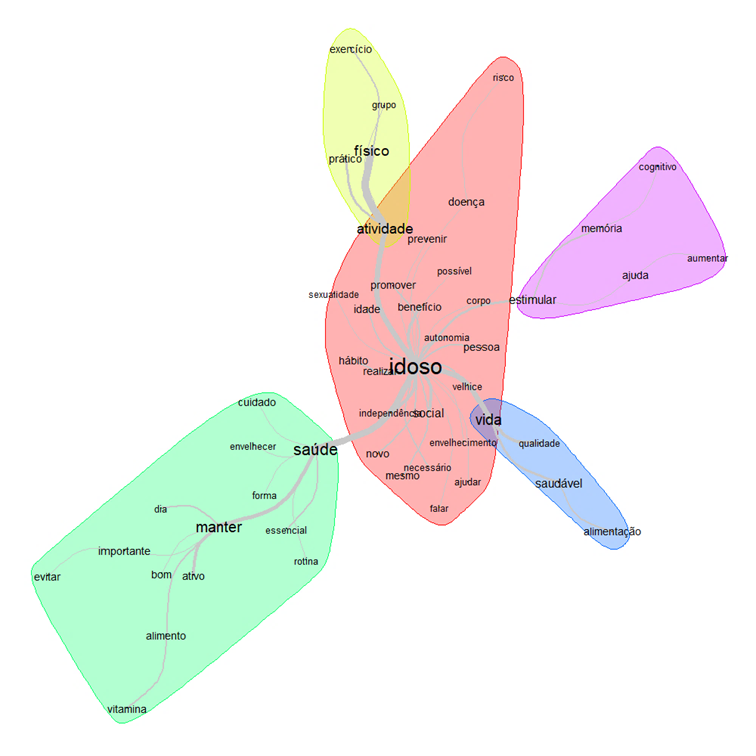
From the similarity analysis, the Maximum Tree (Figure 1) was generated, obtained through 51 words, and indicated that the term "elderly" was central in the analyzed captions, a fact that indicates that all the chosen publications were aimed at providing guidance to the chosen audience. The central term is connected to four similarity trunks, related to the keywords: "stimulate", "activity, physical", "life", and "health, maintain". The graph shows that the recurrence of these terms is indicated by the font size; the larger the font, the more frequently the term was used in the discourse. Furthermore, the greater the thickness of the graph, the greater the connectivity between the words.
Figure 1 - Similarity analysis: guidelines on encouraging self-care in promoting active aging. Ilhéus, Bahia, Brazil, 2024
Source: developed by the authors using the software IRAMUTEQ (2024).
After selecting the material, performing a preliminary reading, and coding the data, four categories of analysis emerged, listed below.
3.1 Social interaction and cognitive stimulation as cornerstones of healthy aging.
This category is associated with the word "stimulate," mentioned 27 times, showing connections with the terms "help," "memory," "cognitive," and "increase," highlighting the value that health professionals attribute to stimulating social interaction and cognitive activities as a key factor for self-care, as can be seen in the captions below:
Care for the mind and body should be accompanied by social well-being. Talking with friends and relatives, engaging in leisure activities, acquiring new knowledge, and sharing smiles are great ways to stimulate interaction with other individuals and greatly benefit the quality of life of the elderly. (P42)
It is necessary to stimulate intellectual activities in order to strengthen the memory and cognitive functions of the elderly. Simple habits, such as doing word searches, playing cards, reading books and magazines, and even attending courses, can make all the difference. (P67)
The use of social networks by the elderly is important because it shortens distances and brings people closer, strengthening affective bonds and combating loneliness. (P60)
3.2 Promoting sleep and healthy eating for disease prevention.
The word "life," mentioned 46 times, is surrounded by the terms "quality," "healthy," and "nutrition." The keywords "maintain" and "health" are found around the words "food" and "vitamin." The profiles analyzed in this study address how poor nutrition and sleep deprivation can diminish quality of life and compromise active and healthy aging, as explained in the following statements from the professionals:
[...] a balanced and healthy diet is fundamental for maintaining and restoring health, as well as preventing the onset of diseases. With the right variety of foods, pre-established schedules, frequency, and correct portions, the diet generally provides all the nutrients that older adults need to maintain their health and nutrition. (P44)
Sleeping well is essential for waking up well. Having good nights of sleep is one of the pillars of a good quality of life. Sleeping few hours a day can contribute to obesity, memory problems, decreased immunity, and can also leave older adults in a bad mood. (P42)
3.3 The importance of physical activity and integrative practices in promoting self-care.
The phrase trunk formed by the terms "activity" and "physical," both mentioned 45 times, showed a connection with the keywords "practice," "group," and "exercise." According to an Instagram post, water aerobics is a great example of physical activity that can be incorporated into the daily routine of the elderly because:
It improves cardiovascular performance and conditioning. It improves motor coordination. It helps with muscle relaxation, preventing pain and potential injuries. It improves breathing along with the circulatory system. All these benefits of physical activity for the elderly contribute to the autonomy and independence they need, meaning more quality of life and well-being. (P11)
One of the search results found that music therapy and dance were alternative ways to promote self-care, as reported by the following profiles:
[music therapy] It can bring many health benefits in addition to relaxation and well-being. Its main benefits are: it activates the mind, stimulates our creativity, intelligence and productivity; helps to increase concentration and attention; reduces anxiety and stress levels; lowers blood pressure, heart rate and breathing rate; an excellent ally in the physical rehabilitation of psychiatric patients; improves the mobility of patients with Parkinson's disease. (P27)
Dance: Stimulates physical activity and motor coordination. Reduces the risk of falls and promotes socialization. Improves self-esteem and quality of life. (P63)
3.4 The self-perception/self-esteem of the elderly in promoting active aging.
According to Instagram posts, self-esteem can also be related to self-perception, as the way older adults see themselves relates to self-love and their lifestyle. The following are excerpts:
The perception of self-image and self-esteem are intrinsically related and are fundamental psychological aspects for well-being and confidence throughout the aging process. (P34)
Positive self-esteem is a prerequisite for a life with more well-being and health, therefore, it is part of healthy aging. Through it, we become more able to understand and overcome life's adversities, always respecting and defending our own interests and needs, knowing that we have the right to be happy. (P25)
DISCUSSION
The central word “elderly” appears linked to terms such as “autonomy”, “habit”, “independence”, “aging”, “prevent”, “promote”, “sexuality”, “social”. In this sense, it can be inferred that, in general, the participants’ discourses, in addition to presenting references that, according to the literature presented, are inherent to the process of promoting active and healthy aging, also place the elderly in an active position in promoting self-care, as a protagonist in the transformation and maintenance of their health, in order to achieve good lifestyle habits.
Regarding the category that addresses social interaction, socio-family relationships are of paramount importance for the quality of life of the elderly, as this welcoming is able to promote and stimulate the development of skills for carrying out ADLs and IADLs, with significant improvements in the cognitive, behavioral, mental, social and physical well-being areas(11).
In this sense, as a way to enable social stimulation in old age, there are Senior Citizen Centers that aim to promote autonomy and healthy aging, preventing social isolation, strengthening friendship networks and offering continuing education, stimulating physical, socio-educational, artistic and cultural activities(12).
In this context, the internet is also an environment in which the elderly can access information on a variety of interests, expanding knowledge, entertainment, job opportunities and communication. In addition, it can integrate older people in a more socially active way in the current world, providing new opportunities and perspectives for social interactions(13).
Regarding cognitive stimulation, it is known that as a person ages, changes occur in the structure and functioning of the brain, resulting in cognitive decline(14). Thus, Instagram posts also encourage the elderly to participate in neurocognitive rehabilitation programs, which include playing games and other interactive and occupational activities. Games contribute to the rehabilitation of cognitive functions impaired due to injuries or illnesses, resulting in increased functionality and a more comfortable life for the elderly(14).
Concerning sleep promotion, studies affirm that regular sleep is fundamental for a good quality of life, being an important indicator of vitality and health in several dimensions: physical, emotional, cognitive and mental. Irregular sleep can negatively impact well-being and health, increasing the risk of developing aggravating conditions, such as chronic diseases, respiratory illnesses, obesity, dementia, stress, anxiety, depression, and can even result in death(15).
There is a mutual relationship between food and sleep. People with sleep disorders tend to have less healthy eating habits than those who have regular sleep, in addition to presenting disorders that affect appetite and the feeling of satiety, contributing to the increase in obesity(16,17). People who sleep less tend to opt for energy-rich foods to replace the deficit, such as energy drinks, and consume smaller portions of vegetables. These imbalances occur due to disturbances in the biological rhythm, leading to hormonal destabilizations that increase calorie intake and prolong the period of wakefulness(17).
Nutritional guidance and sleep play crucial roles in promoting self-care among the elderly. A balanced diet, adequate to the nutritional needs of this age group, is fundamental for disease prevention and strengthening the immune system(18). Moreover, sleep quality affects the physical and mental health of the elderly, directly influencing their ability to maintain an active and independent lifestyle.
The discourses also showed that the practice of physical activity plays an important role in improving the functional capacity of the elderly, in independence to perform activities of daily living, in social interaction and in mental health(19).
Water aerobics has recently been sought after by individuals in their senior years. The use of music and a variety of equipment such as sticks, floats and dumbbells, making the classes more stimulating and cheerful, contributes to stress reduction. Another advantage of this type of exercise is body buoyancy, which reduces impacts and body weight, thus reducing the risk of injury(20).
Integrative practices are also ways to stimulate the performance of physical and mental activities. Music therapy, for example, uses music as a tool for promoting health, demonstrating that it is possible to explore skills, recover and prevent illnesses through sound elements(21). Currently, it has become common for elderly people to participate in dance groups. This modality helps to strengthen the joints, provides a feeling of well-being, making the elderly more active and helps with body awareness(22).
In this sense, in old age, self-perception is related to the connection between health and functional capacity(23). Therefore, it is important to understand the elderly person's self-assessment regarding the moment they are in at this stage of life. The fact that aging is a continuous and internal process, marked by various physical and psychological transformations that can have negative impacts on the elderly person's ability to adapt to the environment in which they live, can affect their self-esteem(24). Being elderly does not prevent living old age fully, on the contrary, aging provides achievements that might not have been possible in youth.
Finally, due to the nature of the qualitative research, which focused exclusively on one social network, the results cannot be generalized, thus presenting some specific limitations. The shortcomings of this netnographic study include restrictions related to data collection, as only public profiles are available for analysis. This approach restricts access to deeper and more contextual information that could be obtained through methods such as qualitative research with interviews. Authors who explore this topic through other methodologies can obtain more comprehensive and detailed insights into the behavior and experiences of the participants, thus complementing the gaps left by the netnographic approach.
Furthermore, despite the advancement in the use of digital technologies by the elderly population, many still do not have access to these resources due to socioeconomic conditions and instructional limitations linked to the level of education. In addition, less familiarity with these devices and possible cognitive limitations contribute to this digital exclusion. These barriers hinder the full integration of the elderly into the digital world, highlighting the need for public policies that promote digital inclusion and continuing education for this age group.
FINAL THOUGHTS
The use of Instagram as a health education strategy to promote self-care can be a significant facilitator for active and independent aging in older adults. The platform allows the dissemination of information about healthy practices, such as the importance of social interaction and cognitive stimulation, which are fundamental for fruitful aging.
For healthcare professionals, Instagram can be a tool to share knowledge and experiences, as well as promote continuing education and networking in the field. The general population also benefits from having continuous and free access to relevant information about health care, being able to adopt healthier habits and seek professional guidance when necessary.
Another important discussion involves combating fake news on Instagram, which is crucial to protecting older adults. Effective strategies include promoting digital education, strengthening information verification policies on the platform, and public awareness campaigns that encourage the verification of reliable sources before sharing.
In short, the use of Instagram as a health education method to promote self-care can be an effective strategy to stimulate active and independent aging in older adults, benefiting both nursing professionals and the general population.
REFERENCES
1. Oliveira AS, Rossi EC. Envelhecimento populacional, segmento mais idoso e as atividades básicas da vida diária como indicador de velhice autônoma e ativa. Geosul [Internet]. 2019 [acesso 2025 Abr 14];34(73):358–77. Disponível em: http://doi.org/10.5007/1982-5153.2019v34n73p358.
2. Silva BBP, Oliveira GS. Autonomia e autocuidado como conceitos determinantes para a adoção do comportamento ativo na velhice. Colloq [Internet]. 2021[acesso 2025 Abr 14]:e015–e015. Disponível em: https://educacaoecienciasdasaude.emnuvens.com.br/recs/article/view/15/21.
3. Bernardes PCF. Utilização do aplicativo Instagram® como ferramenta de educação em saúde sobre aleitamento materno [Trabalho de Conclusão de Curso]. Goiânia (Brasil): Pontifícia Universidade Católica de Goiás; 2021[acesso 2025 Maio 14]. Disponível em: https://repositorio.pucgoias.edu.br/jspui/handle/123456789/3425.
4. Casadei G, Bennemann R, Lucena T. Influência das redes sociais virtuais na saúde dos idosos. Enciclopédia Biosfera [Internet]. 2019[acesso 2025 Abr 14];16(29):1962–75. Disponível em: https://www.conhecer.org.br/enciclop/2019a/sau/influencia.pdf.
5. Soares SSD, Stengel M. Netnografia e a pesquisa científica na internet. Psicol. USP[Internet]. 2021[acesso 2025 Abr 14];32:e200066. Disponível em: https://doi.org/10.1590/0103-6564e200066.
6. Pinto PA, Brasileiro FS, Antunes MJL, Almeida AMP. COVID-19 no Instagram: práticas de comunicação estratégica das autoridades de saúde durante a pandemia. Comum. Pública [Internet]. 2020[acesso 2025 Maio 14];15(29). Disponível em: https://doi.org/10.4000/cp.11288.
7. Camargo BV, Justo AM. IRAMUTEQ Tutorial [Internet]. Florianópolis: Social Psychology Laboratory of Communication and Cognition; 2021[acesso 2025 Maio 14]. Disponível em: http://iramuteq.org/documentation/fichiers/IRaMuTeQ%20Tutorial%20translated%20to%20English_17.03.2016.pdf.
8. Bardin L. Análise de conteúdo. São Paulo: Edições 70; 2016.
9. Costa NNG, Barreto RS, Souza SS, Brito LP de, Servo MLS. #VACINAPARATODOS: sentidos atribuídos por brasileiros à primeira dose da imunização contra a covid-19 no Instagram. RECIIS [Internet]. 2024 [acesso 2025 Maio 14];28,18(2):344–58. Disponível em: https://doi.org/10.29397/reciis.v18i2.3937.
10. Brasil. Resolução nº 510, de 07 de abril de 2016 [Internet]. Brasília-DF: Conselho Nacional de Saúde; 2016 [acesso 2024 Jan 31]. Disponível em: https://www.gov.br/conselho-nacional-de-saude/pt-br/atos-normativos/resolucoes/2016/resolucao-no-510.pdf/view.
11. Souza Júnior EV, Cruz DP, Siqueira LR, Rosa RS, Silva CS, Biondo CS, et al. Is self-esteem associated with the elderly person’s quality of life? Rev Bras Enferm [Internet]. 2022[cited 2025 May 14];75(Suppl 4):e20210388. Avaible from: https://doi.org/10.1590/0034-7167-2021-0388.
12. Francisco CM, Pinheiro MA. Espaços de convivência para idosos: benefícios e estratégias. Rev. Recien [Internet]. 2018 [acesso em 14 de maio 2025];8(24):65–72. Disponível em: https://recien.com.br/index.php/Recien/article/view/174/177.
13. Souza SS, Abreu PTC. Sites e aplicativos móveis como estratégias de comunicação durante a pandemia de Covid-19 no Brasil. REVISA [Internet]. 2023[acesso 2025 Abr 14];12(3):568–74. Disponível em: https://doi.org/10.36239/revisa.v12.n3.p568a574 .
14. Lousa EFCF. Benefícios da estimulação cognitiva em idosos: um estudo de caso. [Dissertação de Mestrado]. Coimbra (Portugal): Instituto Miguel Torga; 2016.
15. Alves HB, Vasconcelos KP, Silva CTL, Silva MNS, Patrício DF, Dantas RR et al. Alterações da qualidade do sono em idosos e sua relação com doenças crônicas. Braz J Health Rev [Internet]. 2020[acesso em 14 de maio 2025];3(3):5030–42. Disponível em: https://ojs.brazilianjournals.com.br/ojs/index.php/BJHR/article/view/10586/8845.
16. Abrahão LA, Camacho ACLF. A importância do enfermeiro no estímulo cognitivo e de memória em pessoas idosas: revisão integrativa. Res Soc Dev [Internet]. 2020[acesso 2025 Abr 14];9(7):e306974180. Disponível em: https://www.researchgate.net/publication/341393759.
17. Fonseca SCF, Mourão-Carvalhal MI, Mendes M, Coelho EMRTC. Dieta e sono no idoso: uma (re)visão. Cad Educ Tecnol Soc [Internet]. 2022[acesso 2025 Abr 14];15(se1):166–71. Disponível em: http://www.brajets.com/index.php/brajets/article/view/997.
18. Ipuchima MT, Costa LL. A importância dos hábitos alimentares saudáveis na terceira idade. Res Soc Dev.[Internet]. 2021[acesso 2025 Abr 14];10(14):e203101421858. Disponível em: https://rsdjournal.org/index.php/rsd/article/view/21858/19504.
19. Menezes GRS, Silva AS, Silvério LC, Medeiros ACT. Impacto da atividade física na qualidade de vida de idosos: uma revisão integrativa. Braz J Health Rev [Internet]. 2020 [acesso 2025 Abr 14];3(2):2490–8. Disponível em: https://ojs.brazilianjournals.com.br/ojs/index.php/BJHR/article/view/8158/7039.
20. Santos GA, Vilela AT. Benefícios físicos da hidroginástica na terceira idade. Rev. Prisma [Internet]. 2020 [acesso 2025 Maio 14];1(2). Disponível em: https://revistaprisma.emnuvens.com.br/prisma/article/view/20.
21. Soares CS, Cirqueira HKS, Barata RCSB, Santos MVF. A eficácia da musicoterapia na prática de enfermagem em pacientes com Alzheimer: uma revisão narrativa. RSD [Internet]. 2022[acesso 2025 Jul 25];11(9):e2811931480. Disponível em: https://rsdjournal.org/index.php/rsd/article/view/31480.
22. Ribeiro CCA, Araújo DDS, Alves HCG, Bisneto ASVC, Oliveira ABF, Ramos JSF et al. A dança como meio de prevenção em idosos com doenças cardiovasculares. BJOH [Internet]. 2025[acesso 2025 Jul 25];2(2):717-23. Disponível em: https://brjohealth.com/index.php/ojs/article/view/152
23. Brasil CHG, Maia LC, Caldeira AP, Brito MFSF, Pinho L. Autopercepção positiva de saúde entre idosos não longevos e longevos e fatores associados. Cienc Saude Colet [Internet]. 2021[acesso 2025 Jul 25];26(suppl 3):5157–70. Disponível em: https://www.scielo.br/j/csc/a/PFy9tr6WgbCyyyVjBvpgLNp/.
24. Figueira O, Perini CC, Sganzerla A, Marcellini PS. Autoestima e estética na percepção de pessoas idosas de Centros de Referência de Assistência Social. Rev Bras Geriatr Gerontol [Internet]. 2024[acesso 2025 Jul 25];27:e230193. Disponível em: https://doi.org/10.1590/1981-22562024027.230193.pt.
Funding and Acknowledgments:
This research received no funding.
Conflict of Interest Statement
Nothing to declare.
Data Availability Statement
No databases were generated in this study. The information presented is described in the body of the article.
Authorship Criteria (Author Contributions)
Gabrielle Soares Rehem: Contributed substantially to the conception and/or planning of the study; to the acquisition, analysis, and interpretation of the data; as well as to the writing and final approval of the published version.
Simone Santos Souza: Contributed substantially to the conception and/or planning of the study; to the acquisition, analysis, and interpretation of the data; as well as to the writing and final approval of the published version.
Rejane Santos Barreto: Contributed substantially to the conception and/or planning of the study; to the acquisition, analysis, and interpretation of the data; as well as to the writing and final approval of the published version.
Samira Silva Santos Soares: Contributed substantially to the conception and/or planning of the study; to the acquisition, analysis, and interpretation of the data; as well as to the writing and final approval of the published version.
Mariane Teixeira Dantas Faria: Contributed substantially to the analysis and interpretation of the data; as well as to the writing and final approval of the published version.
Rutinhea Santos de Santana: Contributed substantially to the analysis and interpretation of the data; as well as in the drafting and final approval of the published version.
Andreia Silva Rodrigues: Contributed substantially to the analysis and interpretation of the data; as well as to the drafting and final approval of the published version.
Scientific Editor: Ítalo Arão Pereira Ribeiro. Orcid: https://orcid.org/0000-0003-0778-1447
Rev Enferm Atual In Derme 2026;100(2): e026058