REVIEW ARTICLE
NURSING CHALLENGES AND STRATEGIES IN THE PREVENTION OF HOSPITAL INFECTIONS IN OPERATING ROOMS
DESAFIOS E ESTRATÉGIAS DE ENFERMAGEM NA PREVENÇÃO DE INFECÇÕES HOSPITALARES EM CENTROS CIRÚRGICOS
DESAFÍOS Y ESTRATEGIAS DE ENFERMERÍA EN LA PREVENCIÓN DE INFECCIONES HOSPITALARIAS EN CENTROS QUIRÚRGICOS
https://doi.org/10.31011/reaid-2026-v.100-n.2-art.2727
Sônia Maria Benício Lopes¹
Alzira Maria Nunes Soares Bezerra2
Vanessa Sousa Bastos3
Angelica Gilderllany Sousa Silva4
Joelma Muniz da Silva5
Aline Borges de Araújo6
Adriana Quaresma de Souza Carvalho7
Andreza da Silva Fontinele8
¹ Enfermeira. Centro Universitário Uninassau. Teresina (PI), Brazil. ORCID: https://orcid.org/0009-0005-1466-2990
² Graduanda em Enfermagem pela Universidade Estadual do Piauí (UESPI). Teresina (PI), Brazil. ORCID: https://orcid.org/0009-0006-4010-3137
3 Enfermeira, Mestranda em Enfermagem, Universidade Federal do Piauí – Teresina (PI), Brazil. ORCID: https://orcid.org/0000-0002-3935-221X
4 Enfermeira. Graduada em neonatologista. Faculdade Estácio. Teresina (PI), Brazil. ORCID: https://orcid.org/0000-0003-3504-4161
5 Enfermeira. Faculdade Estácio de Sá. Teresina (PI), Brazil. ORCID: https://orcid.org/0000-0001-8242-7611
6 Enfermeira. Faculdade Estácio de Sá. Teresina (PI), Brazil. ORCID: https://orcid.org/0000-0003-1815-3868
7 Enfermeira. Universidade Federal do Piauí. Teresina (PI), Brazil. ORCID: https://orcid.org/0000-0002-0772-5800
8 Enfermeira, Mestranda em Enfermagem, Universidade Federal do Piauí – Teresina (PI), Brazil. ORCID: https://orcid.org/0000-0002-3239-357X
Corresponding Autor
Sônia Maria Benício Lopes
Quadra X, casa 12, Residencial Mário covas, Teresina-Piauí (PI). Brazil. CEP: 64034626. phone: +55(86) 995087181. E-mail: soniamaria1092@gmail.com.
Submission: 29-01-2026
Approval: 24-04-2026
ABSTRACT
Introduction: Hospital-acquired infections, especially Surgical Site Infection (SSI), represent a significant public health problem, being associated with increased morbidity and mortality, hospital stay, and healthcare costs. The operating room is a high-risk environment due to the complexity of procedures and the variability in professional qualifications. Objective: To analyze the challenges faced and the strategies adopted by nurses in the prevention of hospital-acquired infections in the operating room. Method: An integrative literature review was conducted in the MEDLINE, LILACS, IBECS, BDENF, PUBMED, and Web of Science databases between 2020 and 2025. Original studies addressing the role of nurses in infection prevention in the operating room were included. Selection followed eligibility criteria based on the PICo strategy, and the evidence was synthesized descriptively and interpretively. Results: The final sample consisted of 8 studies. The results indicate that the knowledge, attitude, and practice of nurses are critical factors for the effectiveness of prevention measures. Good adherence to some evidence-based practices was observed, while others, such as preoperative handwashing and proper antibiotic administration, showed shortcomings. Continuing education, structured programs, auditing, and institutional support emerge as key strategies to strengthen patient safety. Final considerations: Nursing plays a decisive role in the prevention of hospital-acquired infections in surgical centers. The findings reinforce the need for continuous training, systematic monitoring, and institutional support, contributing to the consolidation of safe practices and informing institutional policies and protocols.
Keywords: Surgicenters; Nurses; Cross Infection; Perioperative Nursing.
RESUMO
Introdução: As infecções hospitalares, especialmente a Infecção do Sítio Cirúrgico (ISC), representam importante problema de saúde pública, sendo associadas a aumento de morbimortalidade, permanência hospitalar e custos assistenciais. O centro cirúrgico é um ambiente de risco elevado devido à complexidade dos procedimentos e à variabilidade da qualificação profissional. Objetivo: Analisar os desafios enfrentados e as estratégias adotadas pelos enfermeiros na prevenção de infecções hospitalares no centro cirúrgico. Método: Revisão integrativa da literatura realizada nas bases MEDLINE, LILACS, IBECS, BDENF, PUBMED e Web of Science, entre 2020 e 2025. Foram incluídos estudos originais que abordassem a atuação dos enfermeiros na prevenção de infecções no centro cirúrgico. A seleção seguiu critérios de elegibilidade baseados na estratégia PICo e as evidências foram sintetizadas de forma descritiva e interpretativa. Resultados: A amostra final foi composta por 8 estudos. Os resultados indicam que o conhecimento, a atitude e a prática dos enfermeiros são fatores críticos para a eficácia das medidas de prevenção. Observou-se boa adesão a algumas práticas baseadas em evidências, enquanto outras, como lavagem pré-operatória das mãos e administração adequada de antibióticos, apresentaram falhas. A educação contínua, programas estruturados, auditoria e suporte institucional emergem como estratégias centrais para fortalecer a segurança do paciente. Considerações finais: A enfermagem desempenha papel decisivo na prevenção de infecções hospitalares em centros cirúrgicos. Os achados reforçam a necessidade de capacitação contínua, monitoramento sistemático e suporte institucional, contribuindo para consolidar práticas seguras e subsidiar políticas e protocolos institucionais.
Palavras-chaves: Centros Cirúrgicos; Enfermeiras e Enfermeiros; Enfermagem Perioperatória; Infecção Hospitalar.
RESUMEN
Introducción: Las infecciones nosocomiales, especialmente la infección del sitio quirúrgico (ISQ), representan un importante problema de salud pública, asociándose con un aumento de la morbilidad y la mortalidad, la estancia hospitalaria y los costes sanitarios. El quirófano es un entorno de alto riesgo debido a la complejidad de los procedimientos y la variabilidad de las cualificaciones profesionales. Objetivo: Analizar los retos a los que se enfrentan y las estrategias adoptadas por el personal de enfermería en la prevención de infecciones nosocomiales en el quirófano. Método: Se realizó una revisión integradora de la literatura en las bases de datos MEDLINE, LILACS, IBECS, BDENF, PUBMED y Web of Science entre 2020 y 2025. Se incluyeron estudios originales que abordaran el papel del personal de enfermería en la prevención de infecciones en el quirófano. La selección siguió los criterios de elegibilidad basados en la estrategia PICo, y la evidencia se sintetizó de forma descriptiva e interpretativa. Resultados: La muestra final estuvo compuesta por 8 estudios. Los resultados indican que el conocimiento, la actitud y la práctica del personal de enfermería son factores críticos para la eficacia de las medidas de prevención. Se observó una buena adherencia a algunas prácticas basadas en la evidencia, mientras que otras, como el lavado de manos preoperatorio y la administración adecuada de antibióticos, mostraron deficiencias. La educación continua, los programas estructurados, la auditoría y el apoyo institucional se perfilan como estrategias clave para fortalecer la seguridad del paciente. Consideraciones finales: La enfermería desempeña un papel decisivo en la prevención de infecciones nosocomiales en centros quirúrgicos. Los hallazgos refuerzan la necesidad de capacitación continua, monitoreo sistemático y apoyo institucional, contribuyendo a la consolidación de prácticas seguras e informando las políticas y protocolos institucionales.
Palabras clave: Centros Quirúrgicos; Enfermeras y Enfermeros; Enfermería perioperatoria; Infección Hospitalaria.
INTRODUCTION
Hospital-acquired infections, also known as Healthcare-Associated Infections (HAIs), are among the most frequent adverse events associated with healthcare, representing a significant public health problem. According to the Brazilian National Health Surveillance Agency (ANVISA), these infections contribute significantly to increased morbidity and mortality, hospital stay, and healthcare costs, in addition to compromising patient safety and the quality of care provided(1).
HAIs pose an even greater challenge in surgical settings due to the invasive nature of the procedures, direct tissue exposure, and the use of invasive devices and technologies that increase the risk of infection. Although largely preventable, their occurrence remains associated with insufficient adherence to prevention and control measures. Evidence indicates that the systematic implementation of structured infection prevention and control programs can reduce the incidence of these events by more than 70%, provided that healthcare professionals are trained and adhere to recommended practices(2-3).
In this context, the adoption of Standard Operating Procedures (SOPs) constitutes an essential strategy for standardizing safe practices and mitigating healthcare risks, contributing to a significant reduction in the incidence of hospital-acquired infections. In Brazil, Surgical Site Infection (SSI) is the third most frequent cause of healthcare-associated infections (HAIs), with rates ranging from 14 to 16% among hospitalized patients, reinforcing the magnitude of the problem in the surgical center(4-5).
Prevention strategies in surgical centers encompass a set of measures that include hand hygiene, material sterilization, control of patient flow, and maintenance of aseptic technique(6). However, the surgical center is characterized as a complex environment, marked by a multiplicity of procedures, variability in professional qualifications, infrastructure and management deficiencies, as well as intense circulation of professionals, frequent interruptions, and high cognitive demand, factors that constitute important challenges for the effective adherence to institutional protocols(7).
In this scenario, the nurse plays a fundamental role in both care and management actions, acting in the organization of the work process, in the application of safety checklists, in the supervision of the team and in the promotion of safe practices. Inserted in a multidisciplinary environment, this professional performs a strategic function in the prevention of errors, in the guidance of the patient and family, and in the articulation between the different members of the team, contributing decisively to the safety of the surgical patient(8-9).
Recognized as the subject of relevant actions in the prevention of hospital infections, nurses must act in accordance with the protocols established by the Hospital Infection Control Committee (CCIH), responsible for planning, implementing and monitoring prevention and control measures. However, technical knowledge alone does not guarantee consistent adherence to safe practices, being influenced by challenges related to interprofessional communication, working conditions and institutional support(10-11).
Given this context, it becomes essential to understand, in light of the scientific literature, which challenges still limit the performance of nursing and which strategies have proven effective in preventing hospital-acquired infections in surgical centers. Thus, the present study aims to analyze the challenges faced and the strategies adopted by nurses in the prevention of hospital-acquired infections in the surgical center.
METHODS
This is an integrative literature review, developed according to six steps: (a) identification and selection of the theme and formulation of the guiding question; (b) definition of inclusion and exclusion criteria and conducting the literature search; (c) selection of information to be extracted from the included studies; (d) analysis and synthesis of the selected studies; (e) interpretation of the results; and (f) final presentation of the review(12).
For the formulation of the research question, the PICo strategy was used, suitable for studies of a non-clinical nature, in which P (Patient/Problem) refers to nurses, I (Interest) to the prevention of hospital infections, and Co (Context) to the surgical center. Based on this strategy, the following guiding question was developed: “How do nurses act in the prevention of hospital infections in the surgical center?”.
The search for studies was conducted in August 2025 in the databases Medical Literature Analysis and Retrieval System Online (MEDLINE), Latin American and Caribbean Literature in Health Sciences (LILACS), Spanish Bibliographic Index in Health Sciences (IBECS), Nursing Database (BDENF) by the Virtual Health Library (BVS), National Library of Medicine National Institutes of Health (PUBMED), and Web of Science. Controlled and uncontrolled descriptors, identified in the Health Sciences Descriptors (DeCS) and Medical Subject Headings (MeSH), were used, combined using the Boolean operators “AND” and “OR”, as shown in Chart 1.
Chart 1 - Search strategy for the integrative review according to the PICo strategy. Teresina, PI, Brazil, 2026.
|
PICo Strategy |
|||
|
Acronym |
P: Nurses |
I: Prevention of Hospital Infections. |
Co: Surgical center. |
|
Descriptors controlled |
Nurses |
Hospital-acquired infection. |
Perioperative Nursing. |
|
Descriptors non-controlled |
Nurses; |
Nosocomial Infections. |
Surgical Assistance; Surgical Nursing; Preoperative Nursing. |
|
Mesh |
Nurses. |
Cross Infection. |
Perioperative Nursing |
|
Entry Terms |
Nurse; Nursing Personnel,Nursing. |
Health Care Associated Infection; Cross Infections. |
Nursing, Perioperative; Surgical Nursing. |
|
Search Strategy |
|||
|
BVS (MEDLINE; LILACS; IBECS; BDENF) |
(Enfermeiras e Enfermeiros) AND (Infecção Hospitalar OR Infecções Nosocomiais) AND (Centros Cirúrgicos) AND (Enfermagem Perioperatória OR Enfermagem Cirúrgica OR Enfermagem Pré-Operatória). |
||
|
PUBMED Web of Science |
(((Nurses OR Nurse) AND (Cross Infection OR Health Care Associated Infection OR Cross Infections)) AND (Perioperative Nursing OR Nursing, Perioperative OR Surgical Nursing) |
||
Source: Prepared by the authors (2026).
Original studies, published in full, available in complete text, without language restriction, published between 2020 and 2025, addressing the theme of prevention of hospital infections in the surgical center and answering the guiding question of the review were included. Review studies, proceedings, opinion articles without empirical data, monographs, theses, dissertations, incomplete texts, and those published outside the established time frame were excluded.
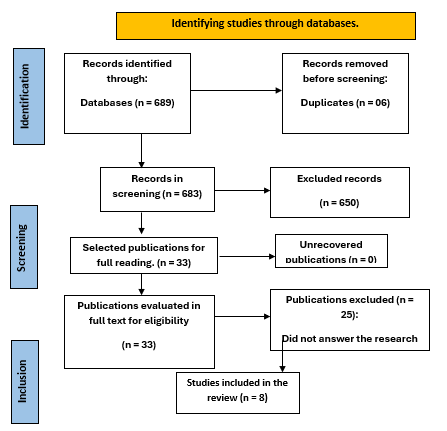
The selection of studies was conducted according to the recommendations of the Preferred Reporting Items for Systematic Reviews and Meta-Analyses (PRISMA)(13), using the flowchart as an instrument to guide the steps of identification, screening, and inclusion of studies. The records retrieved from the databases were exported to the Rayyan platform, which assisted in organizing the initial screening and removing duplicates, providing greater reliability to the selection process.
The search in the selected databases resulted in the identification of 689 records. After removing duplicates, 683 studies were considered for the screening stage. Reading the titles and abstracts resulted in the exclusion of 650 studies for not meeting the previously established inclusion criteria. Subsequently, the availability of full texts was verified, and no studies were excluded due to unavailability of access.
Finally, 33 articles were evaluated for eligibility, with 25 being excluded for not answering the research question. At the end of the selection process, the sample for this review consisted of 8 studies. The search and selection process for the studies is presented in the PRISMA flowchart (Figure 1).
Figure 1 - PRISMA flowchart of the study search and selection process. Teresina, PI, Brazil, 2026.
Source: Prepared by the authors (2026).
The data from the included studies were extracted systematically using an instrument developed by the authors, encompassing information regarding the author and year of publication, study objective, methodological design, and main findings related to the role of nurses in preventing hospital infections in surgical centers. Subsequently, the data were organized into a table and subjected to descriptive and interpretive analysis, allowing for the synthesis of evidence and the construction of a discussion of the results.
RESULTS AND DISCUSSION
The final sample for this integrative review consisted of 8 studies. The characterization of the included articles is presented in Chart 2, which gathers information regarding the author and year of publication, objective, methodological design, and main findings. This data supports the analysis and discussion of the results, allowing for a synthesis of the evidence regarding the role of nurses in the prevention of hospital infections in surgical centers.
Chart 2 – Characterization of the studies included in the integrative review. Teresina, PI, 2026.
|
Title |
Objective |
Methodological design |
Main Findings |
|
Surgical Healthcare Workers Knowledge and Attitude on Infection Prevention and Control: A Case of Tamale Teaching Hospital, Ghana14 |
To assess the knowledge and attitudes regarding infection prevention and control (IPC) among healthcare professionals in the surgical department of Tamale University Hospital (TTH). |
Descriptive and cross-sectional study. |
The professionals demonstrated satisfactory levels of knowledge and positive attitudes regarding infection prevention and control, with a higher proportion among nurses compared to other professional groups. |
|
Determining operating room nurses' knowledge and use of evidence-based recommendations on preventing surgical site infections15 |
To determine the knowledge and use, by operating room nurses, of updated evidence-based guidelines for the prevention of surgical site infections. |
Descriptive and cross-sectional study. |
Good adherence to evidence-based recommendations in nursing management practices was observed, such as surgical scrubbing, normothermia, and the use of sterile gloves, with lower adherence in actions related to preoperative handwashing, control of traffic in the operating room, and the use of prophylactic antibiotics. |
|
Surgical site infection prevention practice and associated factors among nurses working at public hospitals of the western part of southern nation, nationalities, and peoples' region, Ethiopia: A cross-sectional study16 |
To assess surgical site infection prevention practices and associated factors among nurses working in public hospitals in the western part of the country, nationalities and regions of the south, from March 1 to 31, 2020. |
Cross-sectional study. |
It was identified that most nurses demonstrated adequate practices for preventing surgical site infection. Good practices were associated with a higher level of knowledge, positive attitudes, and participation in infection prevention training. |
|
Important interventions in the operating room to prevent bacterial contamination and surgical site infections17 |
To explore interventions that Swedish operating room (OR) nurses considered important for the prevention of bacterial contamination and surgical site infections (SSIs).. |
Cross-sectional study.
|
Twelve important interventions to prevent bacterial contamination and surgical site infection: skin disinfection, operating room environment, aseptic technique, operating room gowns, dressing, preparation, wound care, basic hygiene, normothermia, communication, knowledge, and work strategies. |
|
Compliance with surgical site infection prevention measures in hospitals18 |
To evaluate adherence to surgical site infection prevention and control measures adopted in clinical practice according to the recommendations proposed by the World Health Organization: conducting audits at the time of antibiotic administration, hair removal with an electric clipper/disposable blade, confirmation of material sterility, and monitoring and disseminating surgical site infection rates. |
Cross-sectional observational study. |
Partial adherence to surgical site infection prevention measures was evident, including the use of prophylactic antibiotics, hair removal, surgical site infection monitoring, and confirmation of material sterility. The main non-conformities were related to the appropriate timing of prophylactic antibiotic administration and the disclosure of infection rates. |
|
Nurses’ knowledge regarding recommended practices on using surgical attire in operating theatre19 |
To evaluate the effect of an educational intervention on nurses' knowledge regarding recommended practices for the use of surgical gowns in the operating room. |
Educational pilot study, using a quasi-experimental design. |
Variable knowledge among nurses regarding recommended practices for the use of surgical attire was observed, with gaps in adherence to the recommendations. Educational strategies contributed to improving knowledge. |
|
Knowledge levels of surgical nurses regarding surgical site infections: a cross-sectional evaluation20 |
To determine the level of knowledge of nurses working in surgical clinics regarding surgical site infections.. |
Descriptive and cross-sectional study. |
Gaps were identified in nurses' knowledge of surgical site infection, indicating a need to strengthen educational initiatives.
|
|
Operating room nurses’ knowledge levels on preventing surgical site infections21 |
To determine the knowledge levels of nurses working in the surgical center unit of the Training and Research Hospital of the Izmir Tepecik University of Health Sciences regarding evidence-based practices for the prevention of surgical site infections (SSIs). |
This is a descriptive study. |
The nurses demonstrated greater knowledge about hand hygiene and material sterilization, with gaps identified in aspects related to surgical prophylaxis and skin preparation. |
Source: Prepared by the authors, 2026.
The included studies showed that the nurse's role in preventing hospital-acquired infections in surgical centers is strongly related to their level of knowledge, adherence to evidence-based practices, and participation in educational activities. In general, a predominance of cross-sectional studies was observed, which pointed to both advances and gaps in the implementation of SSI prevention measures.
Nurses presented satisfactory levels of knowledge and positive attitudes, surpassing other professionals in the multidisciplinary team, reinforcing nursing leadership in the implementation of preventive measures. However, the authors emphasize that isolated knowledge does not guarantee the adequate and consistent execution of protocols(14).
Although some procedures, such as the use of sterile gloves, maintenance of normothermia, and surgical scrubbing, show good adherence(15), other essential practices, such as preoperative hand washing, restriction of patient circulation, and administration of prophylactic antibiotics, still demonstrate significant shortcomings,(18). Authors corroborate these findings, noting that nurses showed greater knowledge about hand hygiene and material sterilization, but significant gaps in surgical prophylaxis and skin preparation, highlighting the need for continuous educational strategies (21).
In this context, continuing education emerges as a central strategy for improving clinical practice. The study showed that trained nurses presented better practices and attitudes in the prevention of SSIs, while (16) and (19) showed an increase in the professionals' knowledge after an educational intervention aimed at the correct use of surgical gowns. Although the authors emphasize that the impact can only be sustained if there are continuous programs and adequate structural conditions for practical application.
These studies highlight that the impact of education is only sustained when inserted into continuous and structured programs, supported by adequate conditions for practical application. Similar results are observed in the international literature (22), which demonstrate a reduction of up to 30% in SSI rates when regular training was combined with feedback from the infection control team.
In addition to training, studies highlight the importance of adhering to evidence-based protocols and structural safety measures. (17) highlight key interventions, including skin disinfection, aseptic technique, correct donning and donning of personal protective equipment, and hand hygiene. The dissemination of infection rates, pointed out by (18), serves as a motivating tool for adherence to safe practices and allows continuous monitoring of quality indicators.
Another critical factor identified is the infrastructure and working conditions of professionals. (20) indicate that work overload, high turnover, and lack of material resources reduce the effectiveness of prevention actions. Thus, responsibility for prevention should not fall exclusively on nurses, but be shared with hospital management and public policy makers (22), ensuring institutional support, adequate resources, and the promotion of a safety culture.
In summary, the findings show that the effectiveness of SSI prevention measures depends on multiple interrelated factors: knowledge and continuous training of nurses, adherence to evidence-based practices, audits and monitoring, and structured institutional support. The combination of these elements strengthens patient safety and contributes to the consolidation of a sustainable prevention culture in surgical centers.
LIMITATIONS OF THE STUDY
Although the included studies offer relevant evidence on the role of nurses in SSI prevention, some limitations should be considered. Most of the research has a cross-sectional design, which makes it difficult to analyze causality between knowledge, attitude, and practice. Furthermore, many studies used samples restricted to a single center, which may compromise the generalizability of the findings. Methodological heterogeneity and the heterogeneity of instruments used in the assessment are also observed, making it difficult to directly compare the findings between studies. Therefore, it is necessary to develop future research, preferably longitudinal and multicenter, to better understand the factors that influence adherence to infection prevention measures.
FINAL CONSIDERATIONS
The studies analyzed demonstrated that, despite advances in hospital infection prevention practices in surgical centers, significant gaps related to institutional protocols still persist. In this context, investments in continuous training, systematic monitoring, strengthening the safety culture, improved working conditions, and greater institutional support are fundamental to ensuring safe practices and reducing risks to the health of surgical patients.
The analysis highlights that nursing plays a decisive role in infection prevention, being essential for the implementation of evidence-based strategies. Furthermore, the findings of this review contribute to consolidating the scientific literature on the subject and provide support for the development of methods, resources, and policies that improve prevention practices in surgical centers.
1. Agência Nacional de Vigilância Sanitária (BR). Programa nacional de prevenção e controle de infecções relacionadas à assistência à saúde (PNPCIRAS) 2021-2025. Brasília-DF: ANVISA; 2021.
2. Silva TC, Rodrigues AP. Prevention and control of hospital infection. Res Soc Dev. 2023;12(5):e13612541628. doi:10.33448/rsd-v12i5.41628.
3. Ministério da saúde (BR). 15/5: Dia Nacional do Controle das Infecções Hospitalares. Brasília-DF: Ministério da saúde; 2022.
4. Agência Nacional de Vigilância Sanitária (BR). Critérios diagnósticos de infecção relacionada à assistência à saúde. 1ª ed. Brasília-DF: ANVISA; 2013.
5. Agência Nacional de Vigilância Sanitária (BR). Critérios diagnósticos de infecção relacionada à assistência à saúde. 2ª ed. Brasília-DF: ANVISA; 2017.
6. Silva MS, Gomes SA, Lima SJ, Lima HB. Desafios e soluções na prevenção de infecções hospitalares em unidades de terapia intensiva. Rev Foco. 2025;18(5):e096. doi:10.54751/revistafoco.v18n5-096.
7. Göras C, Olin K, Unbeck M, Pukk-Härenstam K, Ehrenberg A, Tessma MK, et al. Tasks, multitasking and interruptions among the surgical team in an operating room: a prospective observational study. BMJ Open. 2019;9(5):e026410. doi:10.1136/bmjopen-2018-026410.
8. McMullan RD, Urwin R, Gates P, Sunderland N, Westbrook JI. Are distractions, interruptions and disruptions in the operating theatre associated with performance and patient safety? A systematic review and meta-analysis. Int J Qual Health Care. 2021;33(2):mzab068. doi:10.1093/intqhc/mzab068.
9. Perdigão CSL, Nascimento IIGS, Medeiros TMAS. Atuação do enfermeiro na prevenção de eventos adversos no centro cirúrgico [trabalho de conclusão de curso]. Rio de Janeiro: Centro Universitário São José; 2023.
10. Dekker M, Jongerden IP, van Mansfeld R, Ket JCF, van der Werff SD, Vandenbroucke-Grauls CMJE, et al. Infection control link nurses in acute care hospitals: a scoping review. Antimicrob Resist Infect Control. 2019;8:20. doi:10.1186/s13756-019-0476-8.
11. Souza FM, Valério A, Pereira TS. As relações interprofissionais e a atuação do enfermeiro diante do quadro de infecções no centro cirúrgico. Rev Artigos Com. 2021;25:e6205.
12. Sousa LMM, Marques-Vieira CMA, Severino SSP, Antunes AV. Metodologia de revisão integrativa da literatura em enfermagem. Rev Investig Enferm. 2017;2(21):17-26.
13. Page MJ, McKenzie JE, Bossuyt PM, Boutron I, Hoffmann TC, Mulrow CD, et al. The prisma 2020 statement: an updated guideline for reporting systematic reviews. Syst Rev. 2021;10:89. doi:10.1186/s13643-021-01626-4.
14. Alhassan AR, Kuugbee ED, Der EM. Surgical healthcare workers knowledge and attitude on infection prevention and control: a case of Tamale Teaching Hospital, Ghana. Can J Infect Dis Med Microbiol. 2021;2021:6619768. doi:10.1155/2021/6619768.
15. Aktas FO, Damar HT. Determining operating room nurses' knowledge and use of evidence-based recommendations on preventing surgical site infections. J Perianesth Nurs. 2022;37(3):404-10. doi:10.1016/j.jopan.2021.08.012.
16. Tesfaye T, Dheresa M, Worku T, Dechasa DB, Asfaw H, Bune AJ. Surgical site infection prevention practice and associated factors among nurses working at public hospitals of the western part of southern nation, nationalities, and peoples' region, Ethiopia: a cross-sectional study. Front Surg. 2022;9:1013726. doi:10.3389/fsurg.2022.1013726.
17. Wistrand C, Falk-Brynhildsen K, Sundqvist AS. Important interventions in the operating room to prevent bacterial contamination and surgical site infections. Am J Infect Control. 2022;50(9):1049-54. doi:10.1016/j.ajic.2021.12.021.
18. Araujo BS, Oliveira AC. Compliance with surgical site infection prevention measures in hospitals. Acta Paul Enferm. 2023;36:eAPE01714. doi:10.37689/acta-ape/2023AO0171344.
19. Alayemi J, Ten Ham-Baloyi W, Jardien-Baboo S. Nurses’ knowledge regarding recommended practices on using surgical attire in operating theatre. Health SA. 2024;29:2469. doi:10.4102/hsag.v29i0.2469.
20. Yurtseven S, Sisman H. Knowledge levels of surgical nurses regarding surgical site infections: a cross-sectional evaluation. Perioper Care Oper Room Manag. 2025;38:100461. doi:10.1016/j.pcorm.2025.100461.
21. Akbulut I, Atalay S. Operating room nurses’ knowledge levels on preventing surgical site infections. Flora. 2025;30(1):91-9. doi:10.5578/flora.2025011311.
22. Gillespie BM, Harbeck E, Rattray M, Liang R, Walker R, Latimer S, et al. Worldwide incidence of surgical site infections in general surgical patients: a systematic review and meta-analysis. Int J Surg. 2021;95:106136. doi:10.1016/j.ijsu.2021.106136.
Funding and Acknowledgments:
This study was funded by the authors themselves, resulting in the publication of the article, in compliance with CAPES Ordinance No. 206, of September 4, 2018, which provides for the mandatory citation of CAPES. The study was based on an integrative literature review, carried out in the MEDLINE, LILACS, IBECS, BDENF, PubMed and Web of Science databases, from 2020 to 2025. The selection of studies followed eligibility criteria based on the PICo strategy, and the evidence was synthesized in a descriptive and interpretive manner. In this context, the authors are grateful for the opportunity to submit this study to the journal, highlighting the importance of publication for the dissemination of scientific knowledge in the area.
Authorship Criteria (Author Contributions):
The authors met the authorship criteria required by the journal, having contributed significantly to the conception, development, and completion of the study, including study planning, data analysis and interpretation, and critical review of the article.
Sônia Maria Benício Lopes and Angelica Gilderllany Sousa Silva: methodological support and interpretation of results.
Alzira Maria Nunes Soares Bezerra and Vanessa Sousa Bastos: data collection and processing and statistical analysis.
Adriana Quaresma de Souza Carvalho, Joelma Muniz da Silva, and Aline Borges de Araújo: article structuring and contribution to writing and editing the text.
Andreza da Silva Fontinele: critical review and approval of the final version of the manuscript.
Declaration of conflict of interest:
Nothing to declare.
Declaration of data availability
No databases were generated in this study. The information presented is described in the body of the article.
Scientific Editor: Ítalo Arão Pereira Ribeiro. Orcid: https://orcid.org/0000-0003-0778-1447
Rev Enferm Atual In Derme 2026;100(2): e026050