REPORTS
EDUCATIONAL INTERVENTION USING A BOOKLET IN THE CARE OF SURGICAL WOUNDS: AN EXPERIENCE REPORT
INTERVENÇÃO EDUCATIVA COM USO DE CARTILHA NO CUIDADO A FERIDAS OPERATÓRIAS: RELATO DE EXPERIÊNCIA
INTERVENCIÓN EDUCATIVA CON EL USO DE UN FOLLETO SOBRE EL CUIDADO DE LAS HERIDAS QUIRÚRGICAS: RELATO DE UNA EXPERIENCIA
https://doi.org/10.31011/reaid-2026-v.100-n.4-art.2821
1 Aglauvanir Soares Barbosa
2 Ana Clara Martins de Oliveira
3 Mariana Yasmin Soares Freitas
4 Luís Eduardo Castelo do Nascimento Aguiar
5Vitória Régia do Nascimento Souza
1 Universidade Estadual do Ceará. Fortaleza, CE, Brazil. Orcid: https://orcid.org/0000-0003-4909-563X
2 Centro Universitário Católica de Quixadá. Quixadá, CE, Brazil. Orcid: https://orcid.org/0009-0009-4266-2049
3 Centro Universitário Católica de Quixadá. Quixadá, CE, Brazil. Orcid: https://orcid.org/0009-0005-4778-7060
4 Centro Universitário Católica de Quixadá. Quixadá, CE, Brazil. Orcid: https://orcid.org/0009-0000-9964-214X
5 Centro Universitário Católica de Quixadá. Quixadá, CE, Brazil. Orcid: https://orcid.org/0009-0008-0843-8505
Corresponding Author
Aglauvanir Soares Barbosa
Universidade Estadual do Ceará. Av. Dr. Silas Munguba, 1700 - Itaperi, Fortaleza - CE, 60714-903, Brazil. E-mail: glauasb1@gmail.com
Submission: 10-06-2026
Approval: 17-07-2026
ABSTRACT
Introduction: Surgical wounds it presents itself as a significant challenge in the context of surgical care, particularly due to the risk of associated complications such as surgical site infection, dehiscence, and delayed healing. Objective: to report the experience of an educational intervention based on the use of a workbook for the care of patients with surgical wounds. Method: A descriptive study, specifically an experience report, conducted within the scope of an undergraduate research project during the period from 2024 to 2025. The intervention consisted of the development and implementation of an educational workbook used during outpatient consultations. The analysis was conducted in a descriptive and reflective manner. Results: The booklet featured accessible language and structured content, covering wound care, nutrition, signs of infection, and general guidelines. Its use promoted the standardization of instructions, facilitated patient understanding, and contributed to strengthening self-care. Conclusion: The intervention proved effective in promoting self-care, improving understanding of guidelines, and enhancing nursing practice.
Keywords: Health Education; Surgical Wounds; Nursing; Self-Care; Educational Technology.
RESUMO
Introdução: As feridas operatórias configuram-se como um importante problemático no contexto do cuidado cirúrgico, sobretudo em virtude do risco de complicações associadas, como infecção do sítio cirúrgico, deiscência e atraso no processo de cicatrização. Objetivo: relatar a experiência de uma intervenção educativa baseada no uso de cartilha no cuidado a pacientes com feridas operatórias. Método: Estudo descritivo, do tipo relato de experiência, desenvolvido no âmbito de um projeto de iniciação científica, no período de 2024 a 2025. A intervenção consistiu na elaboração e aplicação de uma cartilha educativa utilizada durante atendimentos ambulatoriais. A análise foi realizada de forma descritiva e reflexiva. Resultados: A cartilha apresentou linguagem acessível e conteúdo estruturado, abordando cuidados com curativo, alimentação, sinais de infecção e orientações gerais. Sua utilização favoreceu a padronização das orientações, facilitou a compreensão dos pacientes e contribuiu para o fortalecimento do autocuidado. Conclusão: A intervenção mostrou-se eficaz para promover o autocuidado, melhorar a compreensão das orientações e qualificar a prática de enfermagem.
Palavras-chave: Educação em Saúde; Feridas Cirúrgicas; Enfermagem; Autocuidado; Tecnologia Educacional.
RESUMEN
Introducción: Las heridas quirúrgicas constituyen un problema importante en el contexto de los cuidados quirúrgicos, sobre todo debido al riesgo de complicaciones asociadas, como la infección del sitio quirúrgico, la deiscencia y el retraso en el proceso de cicatrización. Objetivo: Describir la experiencia de una intervención educativa basada en el uso de un folleto para el cuidado de pacientes con heridas quirúrgicas. Método: estudio descriptivo, del tipo relato de experiencia, desarrollado en el marco de un proyecto de iniciación científica, en el periodo comprendido entre 2024 y 2025. La intervención consistió en la elaboración y aplicación de un folleto educativo utilizado durante las consultas ambulatorias. El análisis se realizó de forma descriptiva y reflexiva. Resultados: el folleto presentaba un lenguaje accesible y un contenido estructurado, abordando los cuidados con los vendajes, la alimentación, los signos de infección y las orientaciones generales. Su uso favoreció la estandarización de las orientaciones, facilitó la comprensión de los pacientes y contribuyó al fortalecimiento del autocuidado. Conclusión: la intervención resultó eficaz para promover el autocuidado, mejorar la comprensión de las orientaciones y mejorar la práctica de la enfermería.
Palabras clave: Educación en Salud; Heridas Quirúrgicas; Enfermería; Autocuidado; Tecnología Educativa
INTRODUCION
Surgical wounds constitute a significant problem within the context of surgical care, particularly due to risk of associated complications, such as surgical site infection, dehiscence and delay in the healing process.1 Such complications are directly related to increased morbimortality, prolonged length of hospital stay and higher costs for healthcare system, constituting a relevant challenge for clinical practice and care management. In this scenario, the adoption of effective strategies for preventions a monitoring during the post-surgery period becomes essential to ensure favorable clinical outcomes.2
Within nursing, the care for surgical wounds extends beyond its technical dimension, incorporating educational actions aimed at preparing patients for self-care at home. According to Potter and Perry, the health teaching-learning process is essential for promoting patient safety, especially in situations involving continuity of care outside hospital settings. Thus, adequate post-surgery guidelines constitute a central element in the prevention of complications and in strengthening individual’s autonomy.3
In this context, health education stands out as a fundamental strategy in nursing practice, being recognized as a powerful tool for promoting behavioral change, expanding patient’s knowledge, and promoting adherence to therapeutic recommendations.
Among the different educational technologies used in care practice, booklets stand out for their accessibility, low cost, and reach potential, especially in outpatient and community settings.4 These materials enable the systematized organizations of guidelines, combining simple language with visual elements, which favors the learning process and information retention. Furthermore, they enable patients to consult the content whenever necessary, reinforcing the guidelines received during medical care.
From the perspective of nursing theories, Dorothea Orem’s Self-care Deficit Nursing Theory provides important theoretical support for understanding the nurse’s role in the process. According to this theory, nursing care should be directed toward identifying self-care deficits and implementing interventions that promote individual’s capacity to care for themselves.5 Seen in these terms, educational technologies, such as booklets, constitute as fundamental instruments for supporting the development of patient’s autonomy, especially in the context of surgical wound care, which requires continuous medical follow-up and attention to signs of complication.
Despite the recognized importance of educational strategies in post-surgery care, the literature reveals a need for great systematization and analysis of interventions developed in care practice, particularly in relation to use of educational technologies and their contributions to self-care and to the qualification of nursing care. This gap highlights the relevance of studies that explore applied experiences and their implications for clinical practice and vocation training.
In view of this, the present study aims to report on the experience of educational interventions based on the use of a booklet in the care of patients with surgical wounds, highlighting its contributions to self-care, the prevention of complications, and the qualifications of nursing practice.
METHODS
This is a descriptive study of the experience report type, developed within the scope of an undergraduate research project linked to the Nursing program at a higher education institution in the interior of State of Ceará, Brazil. The study concerns the development and application of an educational intervention aimed at the care of patients with surgical wounds, carried out between 2024 and 2025, in different healthcare backgrounds.
The experience was developed in health services that provide follow-up care to patients during the post-surgery period, including outpatient, hospital, and primary health care units, which made it possible to address individuals with different care needs and favored the expansion of reach of the educational actions.
Participants in the experience included patients under post-surgery follow-up and individuals with surgical wounds who required guidelines related to self-care at home. Also involved were nursing students who were members of the project, under the professor’s supervision, who were responsible for mediating the educational actions and for using the institutional material during medical care.
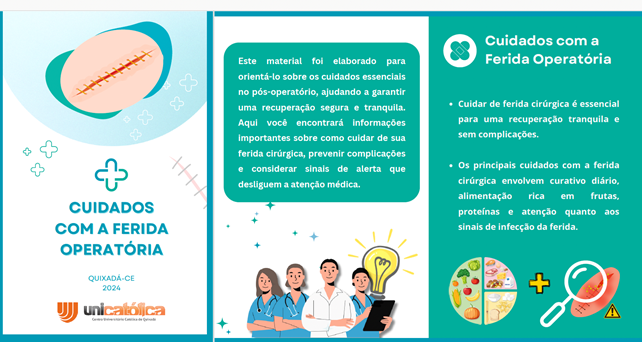
The educational intervention was centered on the use of a booklet titled Cuidados com a ferida operatória (care for surgical wound), developed based on scientific evidence and previously validates for content by experts in the field. The validation process showed a satisfactory Content Validity Index (CVI) of 0.91, confirming the clarity, relevance, and adequacy of the material for the target audience.
The material was structured to include guidelines on wound hygiene, dressing changes, nutrition during the recovery period, signs of infection, suture removal, care while bathing, and general recommendations for the post-surgery period. In addition to its textual content, the booklet incorporated visual resources and didactic organization aimed at facilitating simple communication, reinforcing verbal instructions, and favoring information retention by patients.
The educational actions were carried out individually, during nursing medical care, through a dialogical approach, presentation of the booklet’s content, clarification of doubts, and reinforcement of the key guideline related to home care. The use of the educational material sought to favor the standardization of the information transmitted, expand patient participation in the care process, and strengthen self-care during the pos-surgical period.
For the systematization of the experience, the following analytical axes were considered: the construction and organization of the educational material; the applicability of the booklet in the care settings; the contributions of the intervention to patient’s self-care; and the repercussions of the experience on nursing practice and on the academic training of the students involved. The analysis was conducted in a descriptive and reflective manner, based on observation of the actions performed, the interactions established with patients, and a critical assessment of the intervention’s contributions to health care.
The study was approved by the Research Ethics Committee, under opinion No. 6,857,599, in accordance with the ethical principles set forth in Resolution No. 466/2012 of the National Health Council.
RESULTS
The experience enabled the construction, implementation, and analysis of a structured educational intervention, mediated by printed educational materials, directed at the care of patients with surgical wounds during the pos-surgical period.
The booklet entitled Cuidados com a ferida operatória (care for surgical wound) was developed based on scientific evidence and structured in accessible language, aiming to meet the educational needs of undergoing pos-surgical follow-up. The material presented a sequential didactic organization, divided into topics and used visual resources that facilitated comprehension of the information.
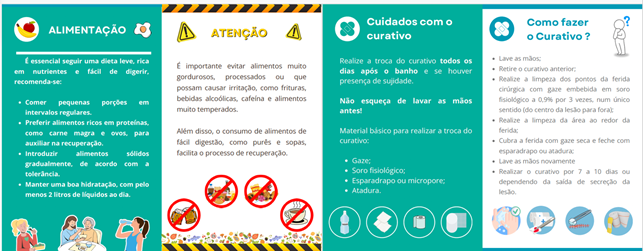
The content included essential guidelines related to home care, including wound hygiene, dressing changes, adequate nutrition, identification of signs of infection, bathing care, and instructions for suture removal. Noteworthy is the inclusion of step-by-step instructions for performing the dressing change, with an emphasis on cleansing with 0,9% saline solution using a one-way technique, adequate coverage of the wound, and hand hygiene before and after the procedure.
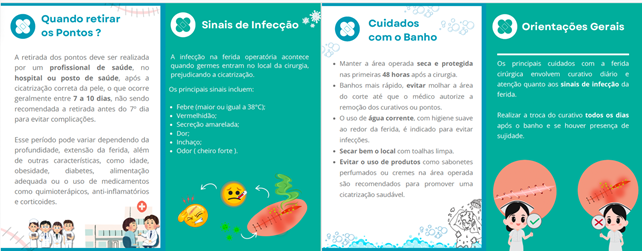
Furthermore, the material addressed aspects related to nutrition during the healing period, encouraging protein intake and adequate hydration, as well as guidelines on habits to be avoided. The identification of signs of infection, such as fever, pain, redness, discharge, and odor, was presented objectively, favoring early recognition of complications.
The booklet also included practical guidelines related to the patient’s daily routines, such as precautions during bathing, keeping the wound protected during the first 48 hours, and the appropriate time for suture removal, reinforcing safety in the recovery process.
Figure 1 – Educational booklet used in the intervention. Quixadá – CE, Brazil, 2025.
|
|
|
|
|
|
The educational intervention was implemented in different healthcare settings, including outpatient, hospital, and primary health care units, allowing its adaptation to different care contexts. The use of the booklet during nursing medical care favored the systematizations of guidelines and contributed to greater organizations of the educational process.
It was observed that the material acted as a mediator of communication between professional and patient, enabling orientations to be conveyed in a clearer, more structure, and visually comprehensible manner. The presence of this educational resource facilitated the conduct of consultations, allowing for greater interaction and active patient participation in the learning process.
The use of the booklet demonstrated potential to strengthen self-care by promoting greater understanding of the guidelines and encouraging the adoption of safe practices in managing surgical wounds at home. Patients showed greater confidence in performing dressing changes and identifying warning signs, evidencing better preparedness for care outside the institutional setting.
Furthermore, during the guidelines’ sessions, frequent doubts were observed regarding the appropriate duration for maintaining the occlusive dressing, the use of topical ointments, the appropriate time for suture removal, the need for wound exposure to air, and local sensations such as pruritus during the healing process. Addressing these questions contributed to clarifying care protocols, reducing insecurities, and strengthening patients’ autonomy in managing the surgical wound at home.
The standardization of guidelines contributed to reducing fragmented information, favoring continuity of care and the prevention of complications. In this sense, the booklet proved to be a relevant tool for promoting patient safety during the pos-surgical period.
In the context of professional practice, the intervention contributed to the qualification of nursing care by favoring the organization and systematization of the guidelines provided to patients. The booklet served as support for the educational process, reinforcing the nurse’s role as a health educator.
For the nursing students, participation in the development and implementation of the booklet enabled the development of competencies related to health education, therapeutic communication, and clinical practice. The experience contributed to the integration of theory and practice, promoting greater confidence in approaching patients and strengthening professional training.
DISCUSSION
The use of educational technologies in the care of patients with surgical wounds has been widely recognized as relevant strategy for promoting self-care and preventing complications during the pos-surgical period.
In this study, the educational booklet proved to be a facilitating resource in the teaching-learning process, favoring the organization of guidelines and communication between professional and patient, and contributing to greater understanding of the information and adherence to care practices.
These findings corroborate evidence in the literature indicating that structured educational interventions are capable of promoting changes in patients’ behavior, especially when associated with didact resources that use accessible language and visual support. The use of printed materials, such as booklets, has stood out for its capacity to reinforce verbal instructions and allow patient to review the information at home, thereby promoting continuity of care and reducing the occurrence of adverse events.6
In the context of pos-surgical care, it is worth highlighting that the transition from the hospital environment to the home represents a critical moment, in which the patient assumes greater responsibility for their own care.7 In this sense, the availability of educational tools helps reduce insecurities, promote autonomy, and support decision-making related to the management of the surgical wound, particularly regarding dressing changes and the identification of signs of complication.8
From a theoretical perspective, the results of this study align directly with the premises of Dorothea Orem’s Self-care Theory, evidencing the nurse’s role in identifying care needs and implementing interventions that favor the development of individual’s autonomy.9 In this context, the educational booklet constitutes a simple tool that supports the educational process, strengthens self-care capacity, and contributes to patient safety.
Furthermore, the standardization of guidelines through the booklet proved to be a relevant aspect for nursing practice, reducing the variability of the information transmitted and favoring the systematization of care. This finding reinforces the importance of using structured educational instruments as support for care practice, especially in services with high-demand settings and diverse range of patient profiles.10
Within academic training, student participation in the construction and application of the educational intervention proved to be a powerful strategy for developing competencies related to health education, therapeutic communication, and clinical practice.11 Furthermore, engagement in real care settings enables a more critical and reflective education, aligned with the needs of contemporary professional practice.
Such as a limitation, it should be noted that the descriptive nature of the study does not allow for establishing casual relationships or generalizing the results. In addition, no standardized instruments were used to assess the impact of the educational intervention, which limits the objective measurement of its effects. However, the experience reported is relevant in demonstrating the applicability of an educational technology within the healthcare context and its contributions to nursing care.
In view of this, future studies with more robust methodological designs are recommended, capable of systematically evaluating the impact of educational interventions on the prevention of complications and the promotion of self-care in patients with surgical wounds. It is also worth emphasizing the importance of incorporating educational technologies into clinical practice as a strategy for qualifying care and strengthening both patients’ autonomy, and nurses’ academic training.
CONCLUSIONS
The experience reported made it possible to demonstrate that the use of an educational intervention mediated by a booklet constitutes a relevant strategy for the care of patients with surgical wounds, favoring the understanding of the guidelines, strengthening self-care, and contributing to the prevention of complications during the pos-surgical period, thereby fulfilling the objective proposed by the study.
From a care perspective, it is worth highlighting that the incorporation of educational technologies into daily nursing practice qualifies the care process by promoting the systematization of guidelines, expanding patients’ autonomy, and reinforcing the nurse’s role as health educator. Furthermore, the experience demonstrated potential to contribute to academic training by enabling the development of competencies related to communication, health education, and clinical practice.
In scientific terms, the findings reinforce the importance of producing and using educational technologies as instruments to support healthcare, demonstrating their applicability in different healthcare settings. However, there is a need for research with more robust methodological designs capable of systematically evaluating the impact of these interventions on clinical outcomes, treatment adherence, and patients’ quality of life.
Thus, the development of further studies that deepen this theme is recommended, especially those integrating quantitative and qualitative approaches, in order to expand the evidence base and support the implementations of unreasoningly effective educational practices in nursing.
REFERENCES
1 Brasil. Agência Nacional de Vigilância Sanitária. Relatório da avaliação nacional das práticas de segurança do paciente em serviços com UTI. Brasília-DF: Anvisa; 2025. Disponível em: https://app.powerbi.com/view?r=eyJrIjoiZGJhM2Q4NjktMjllZC00M2UyLTg0ZjAtNjYzMjZlOWM2MDBjIiwidCI6ImI2N2FmMjNmLWMzZjMtNGQzNS04MGM3LWI3MDg1ZjVlZGQ4MSJ9
2 Dilmen O, Meço B, Evered L, Radtke F. Postoperative neurocognitive disorders: A clinical guide. J clinical anesthesia. 2023; 92: 111320. Doi: https://doi.org/10.1016/j.jclinane.2023.111320.
3 Potter PA, Perry AG. Fundamentos de enfermagem. 9. ed. Rio de Janeiro: Elsevier; 2018.
4 Pires APB, Leite PAR, Oliveira SA, Vasconcelos MG. Tecnologias educativas empregadas no processo de alta hospitalar para apoiar pacientes e cuidadores: revisão integrativa. Rev. enferm. UFPI. 2025;14:e6966. Doi: 10.26694/reufpi.v14i1.6966
5 Araújo TL, Lopes MVO, Vitor AF. Teoria do déficit de autocuidado: análise da sua importância e aplicabilidade na prática de enfermagem. Esc Anna Nery. 2010;14(3):611-6. Doi: https://doi.org/10.1590/S1414-81452010000300025
6 Weidmann A, Sonnleitner-Heglmeier A, Dartsch D. Effect of patient education videos on modifying medication-related health behaviours: A systematic review using the behaviour intervention functions. Patient educ counseling. 2023;117:107992. Doi: https://doi.org/10.1016/j.pec.2023.107992.
7 Hestevik C, Molin M, Debesay J, Bergland A, Bye A. Older persons’ experiences of adapting to daily life at home after hospital discharge: a qualitative metasummary. BMC Health Services Res. 2019;19(1):224. Doi: https://doi.org/10.1186/s12913-019-4035-z.
8 Brandberg C, Ekstedt M, Flink M. Self-management challenges following hospital discharge for patients with multimorbidity: a longitudinal qualitative study of a motivational interviewing intervention. BMJ Open. 2021 Jul 30;11(7):e046896. Doi: https://doi.org/10.1136/bmjopen-2020-046896.
9 Nabila S. Optimizing quality of care by integrating orem's self-care deficit theory with orlando's nursing process theory. i-manager's J Nursing. 2023;13(2): 48. Doi: https://doi.org/10.26634/jnur.13.2.19853.
10 Santos O, Melly P, Hilfiker R, Giacomino K, Perruchoud É, Verloo H, Pereira F. Effectiveness of Educational Interventions to Increase Skills in Evidence-Based Practice among Nurses: The EDITcare Systematic Review. Healthcare (Basel). 2022 Nov 2;10(11):2204. Doi: https://doi.org/10.3390/healthcare10112204.
11 Ambrosetti É, Gaudin C, Flandin S, Poizat, G. Students as co-designers in health professional education: a scoping review. BMC Medical Educ. 2025 May 3;25(1):645. Doi: https://doi.org/10.1186/s12909-025-07110-0.
Funding and Acknowledgments:
This study was developed with the support of the Scientific Initiation Program (PIC) at the Centro Universitário Católica de Quixadá, which contributed to strengthening research and the academic development of students, enabling the execution of scientific projects.
Data Availability Statement
No datasets were generated for this study. The information presented is described within the body of the article.
Conflict of Interest Statement
None to declare.
Authorship Criteria (Author Contributions)
The authors participated in all stages of the study’s development, including literature review, scientific analysis, planning of the educational intervention, presentation of the educational booklet to patients, monitoring of the activities carried out, discussion of the results obtained, and drafting of the manuscript. Furthermore, they contributed to the critical review of the content, ensured compliance with the journal’s guidelines, and provided final approval of the version submitted for publication.
Scientific Editor: Ítalo Arão Pereira Ribeiro. ORCID: https://orcid.org/0000-0003-0778-1447
Rev Enferm Atual In Derme 2026;100(4): e026112