REPORT
EDUCATIONAL TECHNOLOGY FOR SUPPORTED SELF-CARE IN MALIGNANT FUNGATING WOUNDS: AN EXPERIENCE REPORT
TECNOLOGIA EDUCATIVA PARA O AUTOCUIDADO APOIADO EM FERIDAS TUMORAIS MALIGNAS: RELATO DE EXPERIÊNCIA
TECNOLOGÍA EDUCATIVA PARA O AUTOCUIDADO APOYADO EN HERIDAS TUMORALES MALIGNAS: RELATO DE EXPERIENCIA
https://doi.org/10.31011/reaid-2026-v.100-n.4-art.2853
1Larissa Cristina de Castro
2Giovanna Pimentel Pereira
3Karina de Araújo Alves Silva
4Cecília Silva Santos
5Gabriela Gonçalves Amaral
6Fernando de Pilla Varotti
7Danilo Donizetti Trevisan
8Silmara Nunes Andrade
1Discente do Curso de Graduação em Enfermagem da Universidade Federal de São João del-Rei. Divinópolis, Brazil. ORCID: https://orcid.org/0000-0002-3190-8260
2Discente do Curso de Graduação em Enfermagem da Universidade Federal de São João del-Rei. Divinópolis, Brazil. ORCID: https://orcid.org/0000-0001-8117-5192
3Discente do Curso de Graduação em Enfermagem da Universidade Federal de São João del-Rei. Divinópolis, Brazil. ORCID: https://orcid.org/0009-0001-5515-1864
4Enfermeira, doutoranda em Ciências da Saúde pela Universidade Federal de São João del-Rei. Divinópolis, Brazil. ORCID: https://orcid.org/0000-0001-6875-582X
5Enfermeira, Doutora em Ciências pela USP, docente na Escola de Enfermagem da Universidade de São Paulo. São Paulo, Brazil. ORCID: https://orcid.org/0000-0002-9629-2815
6Biólogo, Doutor em Farmacologia pela UFMG, docente do Programa de Pós-graduação em Ciências da Saúde da Universidade Federal de São João del-Rei. Divinópolis, Brazil. ORCID: https://orcid.org/0000-0002-2939-7780
7Enfermeiro, Doutor em Ciências da Saúde pela UNICAMP, docente do curso de Graduação em Enfermagem da Universidade Federal de São João del-Rei. Divinópolis, Brazil. ORCID: https://orcid.org/0000-0002-6998-9166
8Enfermeira, Doutora em Ciências da Saúde pela UFSJ, docente do curso de Graduação em Enfermagem da Universidade Federal de São João del-Rei. Divinópolis, Brazil. ORCID: https://orcid.org/0000-0002-1975-0827
Corresponding Author
Silmara Nunes Andrade
Rua Sebastião Gonçalves Coelho, 400 - Bairro Chanadour - Divinópolis, MG – Brazil. CEP: 35501-296. Phone: +55(37) 3229-2000 E-mail: silmaranunesandrade@ufsj.edu.br
Submission: 06-07-2026
Approval: 19-10-2026
ABSTRACT
Introduction: Malignant fungating wounds (MFWs) pose complex challenges to oncology care and severely affect patients’ quality of life. In Brazil, the Instituto Nacional de Câncer (INCA) estimates approximately 781,000 new cancer cases for each year of the 2026-2028 triennium, which confirms the need for educational technologies intended to guide patients and caregivers. This study aimed to report the experience of developing an educational technology in the form of an information guide (brochure) focused on the management of MFWs, with the purpose of strengthening supported self-care and disseminating information to patients and caregivers, thereby contributing to health education in the oncology setting. Experience Report: This is an experience report of a university extension project (Nursing, UFSJ) carried out between March and July 2025 in partnership with an oncology referral service. The methodological pathway comprised a literature review; text development with didactic transposition; technical review and internal validation; and graphic layout. As a result, an information guide grounded in Orem’s supportive-educative system was developed, which addresses etiology, early identification, and management of signs and symptoms. The technology showed potential to raise health literacy and self-care agency. In conclusion, the guide is an important educational technology for health education, with the potential to strengthen patient autonomy and improve the quality of oncology care.
Keywords: Health Education; Oncology Nursing; Self Care; Educational Technology.
RESUMO
Introdução: As feridas tumorais malignas (FTMs) impõem desafios complexos ao cuidado oncológico, impactando severamente a qualidade de vida dos pacientes. No Brasil, a estimativa do Instituto Nacional de Câncer (INCA) para cada ano do triênio 2026-2028 é de aproximadamente 781 mil novos casos de câncer, cenário que ratifica a necessidade de tecnologias educativas voltadas à orientação de pacientes e cuidadores. O presente estudo teve como objetivo relatar a experiência da construção de uma tecnologia educativa, no formato de guia informativo (folder), voltada ao manejo de feridas tumorais malignas, com o intuito de fortalecer o autocuidado apoiado e disseminar informações para pacientes e cuidadores, contribuindo para a educação em saúde no cenário oncológico. Relato do caso: Trata-se de um relato de experiência de projeto de extensão universitária (Enfermagem/UFSJ), desenvolvido entre março e julho de 2025, em parceria com um serviço de oncologia de referência. O percurso metodológico integrou: levantamento bibliográfico; elaboração textual com transposição didática; revisão técnica e validação interna; e diagramação gráfica. Como resultado, desenvolveu-se um guia informativo fundamentado no Sistema de Apoio-Educação de Orem, abordando etiologia, identificação precoce e manejo de sinais e sintomas. A tecnologia demonstrou potencial para elevar o letramento em saúde e a agência de autocuidado. Conclui-se que o guia constitui uma tecnologia educativa importante para a educação em saúde, com potencial para fortalecer a autonomia dos pacientes e qualificar o cuidado em oncologia.
Palavras-chave: Educação em Saúde; Enfermagem Oncológica; Autocuidado; Tecnologia Educacional.
RESUMEN
Introducción: Las heridas tumorales malignas (HTM) plantean desafíos complejos para el cuidado oncológico y afectan gravemente la calidad de vida de los pacientes. En Brasil, la estimación del Instituto Nacional del Cáncer (INCA) para cada año del trienio 2026-2028 es de aproximadamente 781.000 casos nuevos de cáncer, lo que refuerza la necesidad de tecnologías educativas destinadas a orientar a pacientes y cuidadores. El presente estudio tuvo como objetivo relatar la experiencia de la construcción de una tecnología educativa, en formato de guía informativa (folleto), orientada al manejo de heridas tumorales malignas, con el fin de fortalecer el autocuidado con apoyo y contribuir a la educación en salud en el ámbito oncológico. Relato de Experiencia: Se trata de un proyecto de extensión universitaria (Enfermería/UFSJ), desarrollado entre marzo y julio de 2025, en colaboración con un servicio de oncología de referencia. El recorrido metodológico comprendió las siguientes etapas: revisión bibliográfica; elaboración textual con transposición didáctica; revisión técnica y validación interna; y diseño gráfico. Como resultado, se desarrolló una guía informativa fundamentada en el sistema de apoyo-educación de Orem, que aborda la etiología, la identificación temprana y el manejo de signos y síntomas. La tecnología demostró potencial para mejorar la alfabetización en salud y la capacidad de agencia para el autocuidado. Se concluye que la guía constituye una tecnología educativa importante, con potencial para fortalecer la autonomía de los pacientes y mejorar la calidad del cuidado oncológico.
Palabras clave: Educación en Salud; Enfermería Oncológica; Autocuidado; Tecnología Educativa.
INTRODUCTION
Cancer is one of the leading causes of morbidity and mortality worldwide and represents one of the greatest contemporary public health challenges. In Brazil, estimates for the 2026–2028 triennium indicate approximately 781,000 new cases per year, a figure that reveals the magnitude of the epidemiological burden in the country (1-2). This complex disease, which results from abnormal cell proliferation and the disruption of regulatory mechanisms, is characterized by uncontrolled cell division, insensitivity to inhibitory factors, and high invasive and metastatic potential (2-3).
The progression of oncogenesis, comprising the stages of initiation, promotion, and malignant progression, triggers systemic metabolic and inflammatory responses that culminate in structural tissue changes (2). In this context, malignant fungating wounds (MFWs), which result from the infiltration of neoplastic cells into cutaneous structures, are a complication that is difficult to manage clinically. These lesions are estimated to affect between 5% and 15% of patients with advanced cancer, and their prevalence may reach up to 50% among patients receiving exclusive palliative care in the terminal phase (4).
The growth of MFWs may be exophytic, ulcerative, or mixed. These lesions are often characterized by tumor necrosis, abundant exudate, bleeding, and foul odor. They become sources of bacterial contamination and have a severe impact on the patient’s self-image and quality of life (3,5).
Given the complexity of the oncology setting, nursing plays a central role throughout the continuum of care, from prevention to the specialized management of lesions, as regulated by COFEN Resolutions No. 569/2018 (6) and No. 787/2025 (7). However, clinical effectiveness is intrinsically linked to access to information and to health literacy. Adequate guidance on symptom control and supported self-care in MFWs is not only a harm reduction strategy but also an ethical imperative grounded in the principles of autonomy and non-maleficence (5,7).
Despite the relevance of this topic, there is a gap in educational tools that translate complex scientific information into language accessible to patients and caregivers. From this perspective, the development of educational technologies, such as an information guide (brochure), emerges as a strategic intervention to promote the empowerment of the patient-family dyad and the systematization of care. Therefore, the present study aimed to report the experience of developing an educational technology in the form of an information guide (brochure) focused on MFW management, with the purpose of strengthening supported self-care and disseminating information to patients and caregivers, thereby contributing to health education in the oncology setting.
METHODS
This is an experience report on the development of an educational technology in the form of an information guide (brochure) intended to provide guidance to patients with MFWs and their caregivers. The initiative stems from a university extension project developed by faculty members and students at the Universidade Federal de São João del-Rei (UFSJ), Campus Centro-Oeste Dona Lindu, in Divinópolis, Minas Gerais.
The development team consisted of three students and four faculty members from the Nursing program, as well as three nurses from outside the institution with expertise in oncology and enterostomal therapy. The need for the guide arose from articulation with professionals at a large hospital in the region, who identified a shortage of accessible instructional materials to assist supported self-care at home.
The guide was developed between March and July 2025 in four interdependent stages:
Stage 1: Literature Review and Evidence Synthesis (March 2025)
A high-sensitivity search was conducted in the PubMed, SciELO, and LILACS databases and in guidance documents issued by the Ministério da Saúde, the World Health Organization (WHO), and the Instituto Nacional de Câncer (INCA). The following controlled descriptors (DeCS/MeSH) were used: “Neoplasias/Neoplasms,” “Cuidados de Enfermagem/Nursing Care,” “Tecnologia Educacional/Educational Technology,” and “Manuais como Assunto/Handbooks as Topic,” combined using the Boolean operators AND and OR. The evidence synthesis focused on pathophysiology, control of signs and symptoms (odor, exudate, and pain), hygiene, and identification of warning signs.
Stage 2: Text Development and Didactic Transposition (March to April 2025)
The scientific content was transposed into clear and inclusive language to accommodate different levels of health literacy. Short sentences, active voice, and organization into self-explanatory topics were prioritized. At this stage, the content was structured to cover everything from the etiology of the lesion to practical guidance on everyday management.
Stage 3: Technical Review and Internal Validation (May to June 2025)
The material was reviewed by an expert committee composed of the faculty members and nurses collaborating on the project. The assessment criteria included scientific accuracy, pedagogical adequacy, and appearance. The suggestions led to an increase in font size to make reading easier for older adult patients and a semantic adjustment to the topic on lesion etiology (“what can lead to the onset of the wound”), to simplify complex concepts without losing their technical essence.
Stage 4: Graphic Organization and Final Layout (July 2025)
The layout was created using Canva®, an intuitive online graphic design tool. The visual identity used vibrant colors (orange and yellow) in contrast with neutral tones (gray and white) to enhance legibility. The visual elements came from graphic illustrations already available in Canva®. After final proofreading, the product was submitted for institutional appraisal and subsequent distribution.
Ethical Aspects
As this was an experience report on an extension project focused on the development of an educational technology, with no primary data collection or direct intervention involving human subjects, the study did not require approval by a Research Ethics Committee, in accordance with the Conselho Nacional de Saúde Resolution No. 466/2012 and complementary resolutions.
RESULTS AND DISCUSSION
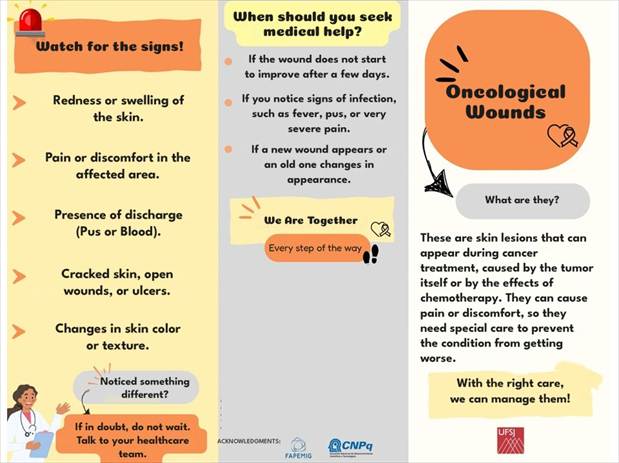
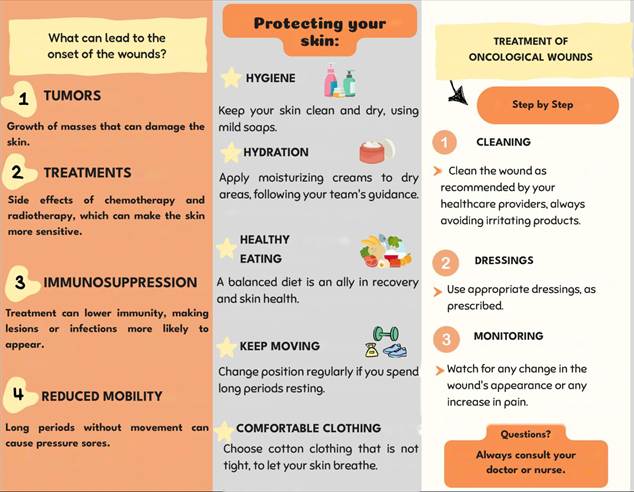
The educational technology, entitled “Feridas Oncológicas” [Oncological Wounds] (Figure 01), was developed as an information guide (brochure) and became established as a low-complexity technology with high clinical applicability. It prioritizes a logical and dialogical structure to facilitate the mediation of knowledge among the professional, the patient, and the caregiver. The material was organized into six strategic axes: 1) “What are they?”; 2) “What can lead to the onset of the wounds?”; 3) “Protecting your skin”; 4) “Treatment of oncological wounds”; 5) “Watch for the signs”; and 6) “When should you seek medical help?”
Figure 01 – Graphic representation of the educational technology “Feridas Oncológicas” (2025).
Source: Prepared by the authors using Canva® (2025).
The content of the guide was structured to transpose the complex scientific content of MFW management into accessible language and was grounded in the concept of health literacy for patients and family members. In this context, access to high-quality information is the cornerstone of supported self-care, as it reduces anxiety and strengthens coping with the disease (8-9). From the perspective of Dorothea Orem’s self-care deficit theory (10), the technology functions as a supportive-educative system in which the nurse provides the resources needed to mitigate the patient’s limitations and promotes the development of competencies for clinical management and the restoration of autonomy (11). Understanding the pathophysiology of MFWs is essential for reducing stigma, since signs such as foul odor, exudation, and bleeding severely affect self-image and contribute to the patient’s social isolation (8).
The theoretical foundation of the guide highlights that MFWs originate from the infiltration of cutaneous structures by neoplastic cells from primary tumors or metastases, which disrupts tissue integrity. In addition, antineoplastic therapies cause dermatological toxicity that weakens adjacent tissues (8). The material emphasizes that the management of these lesions must account for the tissue fragility exacerbated by treatments, as well as risk factors such as immunosuppression and reduced mobility, which are common in advanced stages of the disease. In this context, repair mechanisms become compromised, which contributes to lesion chronicity (12).
Regarding technical execution, the guide’s instructions on MFW management focus on the control of signs and symptoms. Careful cleansing of the lesion is presented as a fundamental step in controlling the bacterial load and reducing complications (12-13). The holistic approach of the guide reaffirms that care must be person-centered and encompass the maintenance of skin hydration, balanced nutrition, and repositioning to preserve skin integrity. It encourages the caregiver and the patient to take an active role in daily care. The technology also addresses the early identification of signs of worsening, enabling the caregiver and the patient to recognize these signs early and encouraging them to seek specialized care in a timely manner (14).
The technology was implemented by delivering the guide to the oncology management team at the referral hospital. The democratization of knowledge and the commitment to the social impact of university extension are ensured by the indexing of the material in a publicly accessible digital repository under DOI [https://doi.org/10.17632/2n4vkzph94.2] (15). This process complied with institutional anonymity protocols and current ethical guidelines.
The main limitation of this study is the absence of external validation by expert judges and the target audience, as the material has undergone only internal validation by the development team to date. Nevertheless, the technology developed represents a relevant contribution to oncology nursing by addressing the shortage of specific instructional materials for MFW management and promoting the democratization of scientific knowledge. The implications for clinical practice are substantial, as the information guide facilitates supported self-care and mitigates communication barriers through didactic transposition. By equipping patients and caregivers, the technology enhances patient safety in the home environment, supports the early identification of complications, and guides them to seek specialized care in a timely manner, which minimizes potential health problems and ensures care centered on the patient’s dignity.
FINAL CONSIDERATIONS
The development of the educational technology “Feridas Oncológicas” became established as an effective strategy for didactic transposition, which converts complex scientific evidence into health literacy resources for the oncology context. The study demonstrated that integration between university extension and health services enhances the quality of home care and the patient’s self-care agency.
The material developed acts as a supportive-educative system grounded in Orem’s theory and offers structured support that fosters the patient’s autonomy and dignity in managing critical signs and symptoms. In conclusion, the technology represents an advance in oncology nursing by providing a practical, humanized, and validated resource that reaffirms health education as the central axis of comprehensive care and a pillar of patient and caregiver safety in the home setting.
REFERENCES
1. Instituto Nacional de Câncer (BR). Estimativa 2026: incidência de câncer no Brasil. Rio de Janeiro: INCA; 2026.
2. Silva MC, Souza PC, Silveira LB, Bezerra JNA, Santos EL, Paixão GP. Atuação da enfermagem na assistência paliativa a pacientes com feridas neoplásicas. Rev Enferm Atual In Derme. 2025;99(3):e025108. Available from: https://doi.org/10.31011/reaid-2025-v.99-n.3-art.2583
3. Zhang M, Li J, Wang X, Liu Y, Chen Z, Zhao H. Advances in cancer immunotherapy: historical perspectives, current developments, and future directions. Mol Cancer. 2025;24:136. Available from: https://doi.org/10.1186/s12943-025-02305-x
4. Nigrelli D, Gambalunga F, Anastasi G, Peghetti A, Durante S, Giusti M, et al. Malignant fungating wounds assessment in palliative care: a scoping review. Front Public Health. 2025 Jun 12;13:1602493. doi: https://doi.org/10.3389/fpubh.2025.1602493
5. Starace M, Carpanese MA, Pampena R, Gurioli C, Bruni F, D'Antuono A, et al. Management of malignant cutaneous wounds in oncologic patients. Support Care Cancer. 2022;30:7615-23. Available from: https://doi.org/10.1007/s00520-022-07194-0
6. Conselho Federal de Enfermagem (Brasil). Resolução COFEN nº 569, de 19 de fevereiro de 2018. Aprova o Regulamento Técnico da Atuação dos Profissionais de Enfermagem em Quimioterapia Antineoplásica. Diário Oficial da União. 20 fev 2018. Available from: https://www.cofen.gov.br/resolucao-cofen-no-569-2018/
7. Conselho Federal de Enfermagem (BR). Resolução COFEN nº 787/2025. Regulamenta a atuação da Equipe de Enfermagem no cuidado aos pacientes com feridas. Brasília-DF: COFEN; 2025.
8. Árbol-Guerrero L, García-Mayor S, Morales-Asencio JM, León-Campos Á, Kaknani-Uttumchandani S, Martí-García C. Effect of patient education in improving quality of life, fatigue and anxiety in people diagnosed with lung cancer: systematic review. Support Care Cancer. 2026;34:159. Available from: https://doi.org/10.1007/s00520-026-10331-8
9. Silva DCCF, Baía AMC, Lima DEOB, Carvalho DS, Santana ME, Silva MJRB. Nurses’ perceptions of mental health care for patients with malignant wounds. Rev Bras Enferm. 2026;79:e20250116. doi: https://doi.org/10.1590/0034-7167-2025-0116pt
10. Orem DE. Nursing: Concepts of practice. 6th ed. St. Louis: Mosby; 2001.
11. Dantas JS, Gomes YLM, Ramos ACMF, Vasconcelos SC, Freire MEM. Determinant Factors of Self-Care Deficit in People With Chronic Wounds: A Scoping Review. J Adv Nurs. 2026 Apr 30. doi: https://doi.org/10.1111/jan.70628.
12. Instituto Nacional de Câncer (BR). Guia para manejo da ferida tumoral maligna cutânea no câncer avançado. Rio de Janeiro: INCA; 2025. Available from: https://ninho.inca.gov.br/jspui/handle/123456789/17714
13. Rodrigues LF, Eloy AVA, Feitosa RP, Nepomuceno AMT, Carvalho AA, Silva MLS, et al. Cuidados Paliativos em feridas neoplásicas: como qualificar a assistência em saúde? Rev Sustinere. 2024;12:9-15. Available from: https://doi.org/10.12957/sustinere.2024.80209
14. Santana LS, Baleeiro LS, Silva MC, Santos EL, Paixão GP, Silveira LB. Extensão universitária como ponte entre saberes acadêmicos e transformação social. Rev Aracê. 2025;7(6):35082-97. Available from: https://doi.org/10.56238/arev7n6-346
15. Castro LC, Silva KA, Pereira GP, Oliveira F, Machado RN, Trevisan DD, et al. Feridas oncológicas: orientações para pacientes e cuidadores. Mendeley Data. 2026;v2. doi: https://doi.org/10.17632/2n4vkzph94.2
Funding and Acknowledgment
FAPEMIG (grant No. APQ-02890/24) and CNPq (grant No.402860/2023-3) for the financial support that made this project possible, as this work stems from a funded project.
Conflict of Interest Statement
None to declare.
Data Availability Statement
No datasets were generated for this study. The information presented is described within the body of the article.
Authorship Criteria (Author Contributions)
The authors of this article made substantial contributions to the conception and/or planning of the study; the acquisition, analysis, and/or interpretation of the data; as well as the drafting and/or critical revision and final approval of the published version.
Scientific Editor: Ítalo Arão Pereira Ribeiro. ORCID: https://orcid.org/0000-0003-0778-1447
Rev Enferm Atual In Derme 2026;100(4): e026118