EDITORIAL
SOLASTALGIA AND NURSING: FROM WOUNDED TERRITORIES TO PLANETARY HEALTH CARE
SOLASTALGIA E ENFERMAGEM: DO TERRITÓRIO ADOECIDO AO CUIDADO EM SAÚDE PLANETÁRIA
SOLASTALGIA Y ENFERMERÍA: DEL TERRITORIO HERIDO AL CUIDADO EN SALUD PLANETARIA
https://doi.org/10.31011/reaid-2026-v.100-n.4-art.2910
Ítalo Arão Pereira Ribeiro1
José Cláudio Garcia Lira Neto2
Ana Lívia Castelo Branco de Oliveira3
Iel Marciano de Moraes Filho4
1Universidade Federal de Mato Grosso do Sul. Coxim, Mato Grosso do Sul, Brazil. ORCID: https://orcid.org/0000-0003-0778-1447. E-mail: arao.italo@ufms.br
2Universidade Federal do Piauí. Floriano, Piauí, Brazil. ORCID: https://orcid.org/0000-0003-2777-1406. E-mail: jclira@ufpi.edu.br
3Universidade Federal do Piauí. Floriano, Piauí, Brazil. ORCID: https://orcid.org/0000-0002-2634-0594. E-mail: analiviacastelobranco@ufpi.edu.br
4Universidade Evangélica de Goiás. Anápolis, Goiás, Brazil. ORCID: https://orcid.org/0000-0002-0798-3949. E-mail: filhoiel@gmail.com
Corresponding Author
Ítalo Arão Pereira Ribeiro
Universidade Federal de Mato Grosso do Sul, Campus Coxim (UFMS/CPCX) - Av. Márcio Lima Nantes s/n, Coxim - MS, Brazil - Postal Code:79400-000 - Phone: +55 67 3291-0202. E-mail: arao.italo@ufms.br
Submission: 28-09-2026
Approval: 28-09-2026
There are losses that do not require leaving in order to be felt. The river remains in the same place, yet it no longer sustains life as it once did; the vegetation that shaped the everyday landscape disappears; heat alters rhythms, relationships, and the possibilities of remaining; droughts, floods, wildfires, and other environmental transformations change not only the material conditions of territories but also the bonds built with them. On a planet marked by an intensifying climate crisis, remaining in a place of belonging does not necessarily mean continuing to recognize it as home. It is within this displacement without departure that solastalgia acquires particular relevance: distress related to unwanted changes in the lived environment, capable of affecting feelings of belonging, security, identity, and continuity with place(1-3).
This editorial argues that solastalgia should be recognized by nursing as a situated expression of environmental distress, without being reduced to a diagnosis, a score, or an individual responsibility to adapt. This understanding broadens an issue that health systems still tend to address in a fragmented manner. The effects of the climate crisis do not reach health services only in the form of respiratory diseases, heat-related illnesses, communicable diseases, injuries, or the immediate consequences of disasters. They are also expressed through fear of further losses, helplessness in the face of environmental deterioration, disruption of ways of life, and the distress of witnessing the transformation of landscapes imbued with memory and meaning. The boundaries between human health and ecosystem integrity are therefore becoming increasingly difficult to sustain. If territory participates in the production of life, its degradation can also participate in the production of suffering(3-5).
Recognizing this relationship, however, requires caution so that a new language does not produce a new form of medicalization. Suffering in response to the destruction of the place where one lives does not, in itself, constitute a mental disorder. Sadness, fear, indignation, grief, and a sense of loss may represent understandable responses to concrete and, at times, irreversible environmental transformations. The challenge lies in recognizing when these experiences affect well-being, everyday life, social bonds, and the capacity to act, without shifting onto individuals a problem whose production is also ecological, social, economic, and political(3-5). Pathologizing solastalgia may transform an experience produced by the deterioration of collective conditions of existence into an individual disorder; ignoring it, on the other hand, means leaving without language or care a form of suffering that the climate crisis is likely to make increasingly present.
As the climate crisis materializes within territories, it affects different dimensions of life and health and directly challenges nursing. Through its longitudinal presence across health services and its close engagement with territories, the profession occupies a strategic position to recognize, address, and respond to the physical, psychosocial, and environmental repercussions of these transformations. Nurses encounter individuals and communities in Primary Health Care (PHC), emergency and disaster care, hospitals, and activities involving surveillance, education, health promotion, and mental health care.
Even so, asking about perceived environmental changes, losses experienced within the territory, and the meanings attributed to these transformations rarely receives the same attention as other determinants of the health–disease process. There is a contradiction in this silence: nurses such as Florence Nightingale and Madeleine Leininger(6). as well as other nursing theorists, have already provided foundations for understanding the relationships among environment, territory, culture, ways of life, and care. Nursing has historically claimed a commitment to holistic care, yet such comprehensiveness remains incomplete when the environment is understood merely as the setting in which life unfolds rather than as a dimension that shapes the very experience of health, illness, and suffering(7,8). Recognizing territory as a component of care does not artificially expand the scope of nursing; rather, it updates that scope in response to environmental conditions that are already reshaping health needs, vulnerabilities, and possibilities for living.
Naming this suffering represents an initial step forward; making it recognizable within care presents another challenge. The Brief Solastalgia Scale (BSS), comprising five items, was developed as a brief measure to assess the experience of solastalgia and has demonstrated favorable psychometric properties(2). In 2026, its adaptation and validation for Brazilian Portuguese, named the BSS-Br, provided the country with a culturally adapted instrument for measuring this form of environmental distress(9). In a country marked by socioenvironmental inequalities and different forms of exposure to ecosystem degradation and extreme climate events, having a validated measure creates new possibilities for research and, potentially, for bringing this phenomenon closer to care settings.
However, translating the availability of the BSS-Br into benefits for care requires more than simply adding five questions to an assessment. The scale does not establish a diagnosis or provide a clinical cutoff point, and its use should not reduce a complex socioenvironmental experience to a decontextualized score(10). In nursing, its potential seems to lie precisely in the opposite direction: using measurement as a gateway to broader listening. A score alone cannot explain what has been lost, why a particular environmental transformation produces distress, who disproportionately bears its effects, or which individual and collective resources remain available. The scale may indicate the presence and intensity of an experience; understanding its roots requires returning to the territory.
This distinction is fundamental because instruments designed to make phenomena visible may also, when used uncritically, individualize problems that are collectively produced. It would be inconsistent to recognize solastalgia only to subsequently place responsibility on individuals to become more resilient in the face of progressively degraded territories. Care cannot be limited to teaching individuals to better endure conditions that remain environmentally unjust. For nursing, the BSS-Br may become meaningful when integrated with assessments of living conditions, territorial bonds, socioenvironmental vulnerabilities, community networks, and possibilities for referral and intervention. In this way, measurement no longer means merely quantifying distress but instead contributes to making it visible within a broader understanding of the health–disease process(8,9).
It is precisely in this shift—from the individual toward the relationships among people, territories, and natural systems—that Planetary Health offers a particularly fruitful perspective for nursing. The climate crisis is no longer understood as a peripheral or exclusively environmental issue but instead directly challenges how care is conceptualized and practiced. For a profession present across different levels of health systems and deeply connected to territories, embracing this perspective means recognizing that caring for people on a changing planet also requires understanding what is happening to the places on which their lives depend(6,7,10).
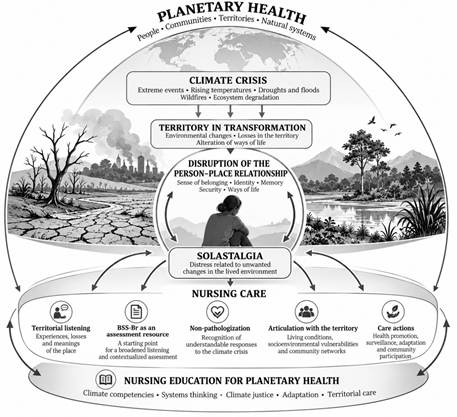
From this perspective, the relationships among the climate crisis, territorial transformation, solastalgia, nursing care, and education in Planetary Health can be understood in an integrated manner, as represented in Figure 1.
Figure 1 – Solastalgia and nursing care from a Planetary Health perspective. Coxim, Mato Grosso do Sul, Brasil, 2026.
Source: Prepared by the authors (2026).
However, expanding the responsibilities assigned to nursing is not enough without asking whether nursing education is keeping pace with the speed of these transformations. Recent evidence points to gaps in the incorporation of socioenvironmental issues and Planetary Health into nursing curricula and calls for the development of knowledge and competencies related to climate change, sustainability, mitigation, adaptation, systems thinking, and their impacts on health(10,12). Educating nurses for the climate crisis, however, should not mean adding yet another isolated topic to already overloaded curricula. The challenge is more profound: to reconsider the very understanding of health that underpins nursing education by bringing the environment, territory, climate justice, mental health, social vulnerabilities, and care into closer dialogue.
This educational shift also requires moving beyond climate education centered exclusively on environmental concepts. Future nurses need to understand the mechanisms through which the planetary crisis produces illness, while also recognizing how environmental transformations shape experiences of belonging, memory, culture, work, and continuity of life within territories. A person who mourns the loss of a landscape, fears that their territory will no longer sustain their family, or no longer recognizes the place where they built their life does not bring to care merely a “climate emotion”; they bring a situated experience produced at the intersection of environmental degradation, social inequalities, and bonds with place. Planetary Health education must prepare nurses to understand these relationships without individualizing collectively produced problems and to integrate care, education, surveillance, socially just adaptation, and community participation(10,12,13).
Brazilian nursing has already been called upon to expand its engagement with this agenda through the incorporation of Planetary Health into education and educational practices, the regulation of work processes concerning the assessment of socioenvironmental aspects, and the recognition of climate change as an issue inseparable from mental health(7,8,13). This call responds to environmental conditions that are already transforming care needs. Providing care as though these transformations were external to professional practice means maintaining responses that are insufficient for a reality in which environment, territory, and health are increasingly inseparable.
Solastalgia therefore makes this insufficiency particularly visible by expressing a paradoxical experience: remaining geographically within the same territory while no longer recognizing it as a place of belonging. Recognizing this distress, critically using instruments such as the BSS-Br, and incorporating Planetary Health into nursing education will not, in isolation, address the structural causes of the climate crisis. They may, however, strengthen listening, make frequently neglected impacts visible, and expand nursing’s capacity to integrate individual care, community action, surveillance, and advocacy for more equitable living conditions.
The challenge facing nursing, therefore, is not merely to learn a new concept or incorporate a new scale. It is to recognize that the climate crisis also permeates subjectivities, bonds, memories, and senses of belonging, and that these dimensions are constitutive, rather than peripheral, to care. When a territory is wounded, it is not only its ecosystems that are transformed; the human relationships built with that territory are transformed as well. Understanding this interdependence is an urgent task for nursing education and practice guided by Planetary Health.
REFERENCES
- Albrecht G, Sartore GM, Connor L, Higginbotham N, Freeman S, Kelly B, et al. Solastalgia: the distress caused by environmental change. Australas Psychiatry. 2007;15 Suppl 1:S95-8. doi: https://doi.org/10.1080/10398560701701288
- Christensen BK, Monaghan C, Stanley SK, Walker I, Leviston Z, Macleod E, et al. The Brief Solastalgia Scale: a psychometric evaluation and revision. EcoHealth. 2024;21(1):83-93. doi: https://doi.org/10.1007/s10393-024-01673-y
- Marques LM, Franco SB. Solastalgia as a warning sign for mental health in a changing environment. Nat Ment Health. 2025;3:1298-9. doi: https://doi.org/10.1038/s44220-025-00515-2
- Vela Sandquist A, Biele L, Ehlert U, Fischer S. Is solastalgia associated with mental health problems? A scoping review. BMJ Ment Health. 2025;28(1):e301639. doi: https://doi.org/10.1136/bmjment-2025-301639
- World Health Organization. Mental health and climate change: policy brief. Geneva: World Health Organization; 2022. Available from: https://www.who.int/publications/i/item/9789240045125
- Pereira JRS, Moraes Filho IM, Tavares GG. Saúde planetária e educação em enfermagem:um novo paradigma ou um retorno às nossas raízes? Rev Enferm Atual In Derme.2026;100(3):e2887. doi: https://doi.org/10.31011/reaid-2026-v.100-n.3-art.2887
- Moraes Filho IM, Tavares GG. Enfermagem atual e futura na promoção da saúde planetária: atuação para o desenvolvimento sustentável. Texto Contexto Enferm. 2024;33:e20230415. doi: https://doi.org/10.1590/1980-265X-TCE-2023-0415pt
- Ribeiro IAP, Moraes Filho IM, Oliveira ALCB, Lira Neto JCG, Tavares GG, Fernandes MA. Climate change and mental health: an urgent call for strategic action from nursing. Rev Bras Enferm. 2026;79:e7904. doi: https://doi.org/10.1590/0034-7167.20267904
- Marques LM, Uchida RR, Monaghan C, Christensen BK, Mangerona BA. Validation of the Brief Solastalgia Scale (BSS-Br): psychometric evidence of environmental distress in the Brazilian population. Environ Psychol Res. 2026;1:e70011. doi: https://doi.org/10.1002/epr2.70011
- Dogan EIK, Ekiz P, Meyer CG. Planetary health education for nursing students: a scoping review. Nurse Educ Today. 2025;153:106812. doi: https://doi.org/10.1016/j.nedt.2025.106812
- International Council of Nurses. Planetary health and climate change. Geneva: International Council of Nurses; 2025. Available from: https://www.icn.ch/news/icn-launches-new-topic-brief-underscoring-vital-role-nurses-protect-planet-human-health-and
- Levett-Jones T, Catling C, Cheer S, Fields L, Foster A, Maguire J, et al. Achieving consensus on the essential knowledge and skills needed by nursing students to promote planetary health and sustainable healthcare: a Delphi study. J Adv Nurs. 2025;81(12):8281-99. doi: https://doi.org/10.1111/jan.16229
- Moraes Filho IM, Fernandes ETBS, Tavares GG. Educação em saúde planetária à luz da Teoria Transcultural de Madeleine Leininger: uma convocação para enfermagem. Rev Enferm Atual In Derme. 2025;99(3). doi: https://doi.org/10.31011/reaid-2025-v.99-n.3-art.2601
Funding and Acknowledgments:
“None to declare”
Conflict of Interest Statement
"None to declare"
Data Availability Statement
No datasets were generated in this study. The information presented is described in the body of the article.
Authorship Criteria (Author Contributions)
Ítalo Arão Pereira Ribeiro, José Cláudio Garcia Lira Neto, Ana Lívia Castelo Branco de Oliveira, and Iel Marciano de Moraes Filho contributed substantially to the conception and/or planning of the study; acquisition, analysis, and/or interpretation of data; as well as drafting and/or critical revision and final approval of the published version.
Scientific Editor: Francisco Mayron Morais Soares. ORCID: https://orcid.org/0000-0001-7316-2519
Rev Enferm Atual In Derme 2026;100(4): e026105